

Colleen Hoover’s career has exploded after gaining massive traction on BookTok, with her dedicated fandom demanding movie adaptations. As a result, Hollywood must rethink its approach to discovering stories, building franchises, and marketing to a new generation of readers. This article explores why Hoover’s rise isn‘t just another trend; it’s fundamentally reshaping the entertainment industry.
Hoover’s ascent to popularity
Colleen Hoover’s first book, Slammed, was self-published in 2012. She has always been a hot commodity in the romance genre, but she has certainly garnered mixed reactions.
Many have accused Hoover of romanticizing abusive relationships and writing problematic power dynamics, a dispute exemplified in It Ends With Us, which also served as Hoover’s first successful movie adaptation. Crucially, much of its popularity stemmed from the controversy surrounding the book, which sparked widespread discourse on TikTok, especially within BookTok, the community where readers share recommendations, reactions, and reading experiences.
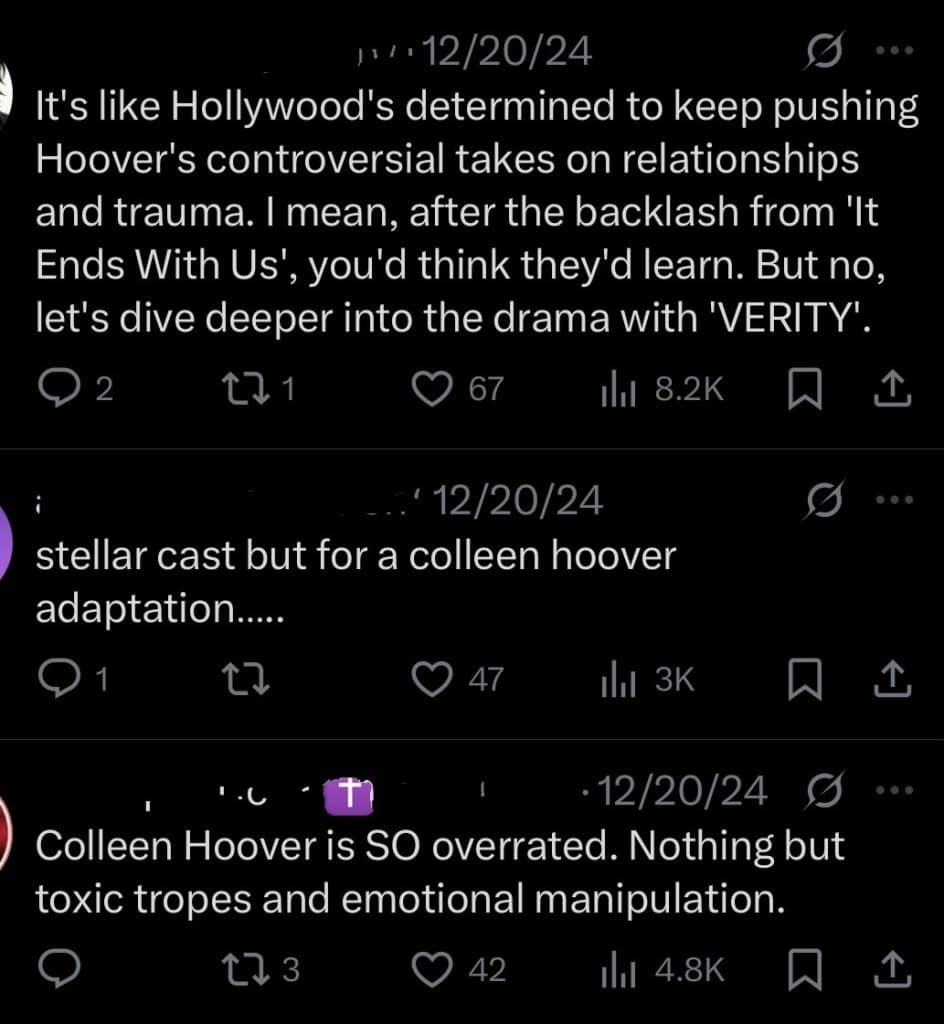
When a post on X revealed the cast for Verity, the online reactions showcased just how polarizing Hoover’s work remains. Comments ranged from expressing frustration with “Hollywood pushing Hoover’s controversial takes” to skepticism about adapting her stories at all. (X/Twitter)
However, this same cocktail of viral praise, viral criticism, and nonstop fan engagement turned It Ends With Us into a box-office success. Controversy and conversation have become central to the marketing logic underlying Hoover’s films, and the consequent success of her adaptations has made her one of the most sought-after names in book-to-screen projects.
The BookTok effect
@caitlinbea Replying to @Karmenti111 Which adaptation are you excited for?! 👀Updates on all the coho book to film adaptations coming up, including cast updates & their expected release dates! Regretting You, Reminders of Him & Verity! #booktok #bookishnews #booknews #remindersofhim #remindersofhimcolleenhoover #colleenhoover #coho #cohobooks #colleenhooverbooks #booktokbooks #adaptation #booktofilm #romancenovels #bestbooktokbooks #verity #veritycolleenhoover #laurengraham #thewhitelotus #popularbooktokbooks #ledgerward #ledger #cast #casting #regrettingyou #annehathaway #dakotajohnson ♬ Lo-fi hip hop – NAO-K
BookTok is the driving force behind it all. Users craft early predictions about whether a show will be a box office hit or not, and Colleen Hoover’s core fanbase, known as the CoHorts, essentially acts as unpaid marketers by relaying their opinions on edits, quotes, and castings. Producers seek precisely this type of fanbase when deciding which projects are worth millions. As stated in an article on Forbes,
“BookTok has become more than a community; it’s now a cultural engine driving what gets read, what gets talked about, and what gets adapted for the screen. As publishers and studios take note, one thing is clear: the next big bestseller (or box office hit) might just start with a swipe.”
TikTok’s growing presence at major literary events shows how seriously the industry is taking BookTok as a pipeline to the screen. At the LA Times Festival of Books, organizers created a panel to unpack the virality of BookTok and its influence on adaptation decisions. Hoover’s adaptations perfectly encapsulate this shift. She not only sells books; she has a ready-made audience before a script is even written.
Hoover’s Hollywood adaptation shift
Hoover’s rise in Hollywood isn’t happening in isolation. Instead, it fits into a broader industry movement where studios are increasingly relying on online reading culture to guide their adaptation choices. In recent years, other adaptations have produced similar results, including The Summer I Turned Pretty on Amazon Prime Video. In fact, its third season was ranked the number one global title on Prime Video. Similarly, Red, White & Royal Blue, also on Prime, was reported as the number one movie worldwide and among the top three most-watched romantic comedy films of all time on Prime. Another recent release is We Were Liars, which just announced a new season. In an interview with the Hollywood Reporter, co-Creators Julie Plec and Carina Adly MacKenzie expressed that “the fan response was truly special.”
These examples demonstrate that book fandoms may be the key ingredient to adaptation success. Even the long-awaited Prime Off-Campus series signals how aggressively platforms are influencing the movement.

Modern adaptations draw from audiences who are already deeply invested, which reduces financial risk while boosting early hype. Studios now see romance and YA (young adult) genre readers as built-in audiences, rife with potential for promotion and engagement.
The future of film
Looking ahead, fandom-driven adaptations raise important questions about the future of moviemaking in Hollywood. On the one hand, highly engaged audiences can elevate stories with a strong emotional impact, catapulting them to the big screen. On the other hand, the trend may narrow production, as studios favor books with the loudest online traction.
In this sense, Hoover presents us with a case study for a new Hollywood model: one where audience engagement doesn’t only predict success; it essentially dictates the course of adaptation. Producers and authors can find what readers loved or hated the most about popular books and exploit their reactions through movie adaptations. For instance, after the controversy of It Ends With Us, studios learned what to avoid and what to use to their advantage.
This monumental shift suggests that the future of book-to-screen projects will be increasingly collaborative and increasingly data-driven. Readers who advocated for stories long before they reached the theater or streaming services will likely be rewarded with new adaptations.