R.F. Kuang is one of the internet’s more divisive authors. Her novels are NYT bestsellers, winning awards and receiving positive reviews from critics. However, her writing has also drawn significant criticism in the online literary community.
As a longtime fan of Kuang’s novels, I am no stranger to the debates on the internet about her work. I first read The Poppy War when I was a sophomore in high school, and it quickly became one of my favorite series. I similarly loved Babel, but Yellowface unfortunately fell short for me. Through the years I’ve been reading Kuang’s books, I’ve found both a lot to enjoy and a lot to critique. She’s still one of my favorite authors, but I completely understand much of the criticism that she faces. Some think that her writing is too heavy-handed; others are unimpressed with her prose and characterization.
I first heard about Katabasis two years ago, and I’ve been excited for it since. Since its publication in August, it’s garnered mixed reviews, like Kuang’s previous work. After reading, I also have some qualms with the book. However, outside of the usual critique, something interesting has come up in the social media discourse. The book has wedged its way into an ongoing conversation about BookTok and the recent rise of anti-intellectualism.
Katabasis Overview
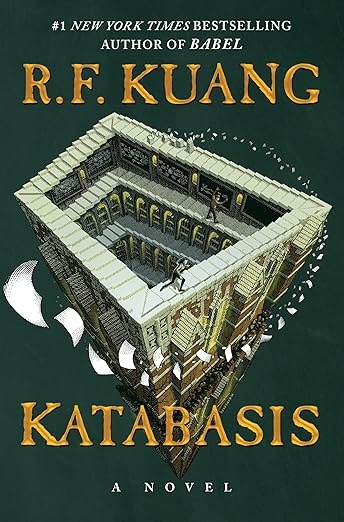
Kuang’s sixth novel, Katabasis, is a stand-alone fantasy novel that follows Alice Law, a PhD student at Cambridge University studying Analytical Magick. One day, her academic advisor, Professor Jacob Grimes, dies in a gruesome accident. Thinking that her career is on the line without him, Alice resolves to travel to Hell to bring him back. The problem is that her academic rival, the charming and fickle Peter Murdoch, decides to come with her too.
Equipped with limited supplies and limited knowledge about the inner workings of Hell, the duo make their descent. They discover that Hell is a university campus. Alice and Peter must learn to overcome their rivalry and work together to find Grimes. However, Hell has other plans, and the pair face various obstacles that threaten to prevent them from making it out.
R.F. Kuang is a current PhD candidate at Yale, and her academic background shines through in the worldbuilding. The magic system of Katabasis treats literary depictions of Hell, such as Dante’s Inferno, as if they were literal nonfiction accounts. Magic is a serious academic discipline that requires just as much theory, math, and philosophy as any. You’ll find a lot of academic terminology and theory throughout the book. Rest assured, though, that full comprehension isn’t necessary to pick up on larger themes or enjoy Katabasis.
There’s also a larger tension between the system of academia and the pursuit of knowledge that’s explored. Despite academia being Hell, Alice, Peter, and Kuang herself, are still academics, and they seem to need to keep learning the way we need to breathe.
My Thoughts on Katabasis
After my disappointment with Yellowface, I didn’t go into Katabasis with very high expectations. Maybe that’s why I ended up having a fun time reading it. To be completely honest, the execution didn’t completely live up to its potential. However, despite my busy schedule, I did finish it in four days because I couldn’t put it down. It was entertaining if nothing else.

Kuang isn’t known for compelling prose or for strong characterization, given her academic background. I thought her previous books were interesting because of their ideas and world-building. Academic critique is where Kuang thrives, so that’s why this book felt weaker to me than her previous work. Not only was the world itself underwhelming, but the actual criticism felt surface-level as well. Compared to Babel or The Poppy War, Katabasis presented as somewhat lackluster.
I was really initially excited about the premise: “academic rivals to lovers in Hell.” But Kuang’s overall construction of Hell was a little bland. There wasn’t as much going on in Hell as one might expect, especially if you’ve read Dante’s Inferno. A lot of the time, the characters spent time in desert-like areas with not much action or visual description.
Meanwhile, Alice and Peter are insufferable protagonists. They frequently make frustrating and self-interested choices, mirroring the cutthroat nature of elite academic institutions in real life. I have nothing against reading unlikeable characters, but I acknowledge that it can put off a lot of readers. At times, I didn’t feel fully invested in Alice’s character.
What kept me reading was the novelty of the magic system and the intrigue of the plot. The pacing felt quite slow at various points, but I still wanted to find out what happened next. I also enjoyed seeing Alice and Peter warm up to each other during their journey. Their banter was definitely more fun than any in previous Kuang books. Overall, while it wasn’t the best example of Kuang’s writing, I had a decent time reading Katabasis.
The Controversy
I’m not here to do a deep dive into the R.F. Kuang controversy, but I do want to address patterns I’ve been seeing online. Many readers and critics bring up points that mirror my own issues: flat characters, slow pacing, underdeveloped worldbuilding, and subpar critique. That’s all fine. I enjoy engaging with thoughtful critique, even if it’s for a book I enjoy. However, in part because Katabasis is such an academic-focused book, I’ve been seeing a lot of conversations about the rise of anti-intellectualism on BookTok and how Katabasis fits into the discourse.
Numerous social media users criticize Katabasis for being “too academic.” They argue that it’s impossible to understand if you don’t have a PhD or haven’t read the academic theory referenced in the novel. Other social media users think that Kuang’s general writing style is “braggy” and intended to show off her own intelligence. Some even think that Katabasis feels AI-generated. While it’s perfectly fine to dislike a book, these criticisms echo a larger cultural shift signaling broader mistrust of intellectuals and academia.
On the other hand, I’ve also seen people brush aside genuine critique of Katabasis and Kuang’s previous works by saying that anyone who didn’t enjoy the book just can’t read or is too stupid to understand Kuang’s writing style. This, too, feels disingenuous, reinforcing the issue of elitism in academia that Kuang seeks to critique. This elitism, all too often romanticized by the dark academia aesthetic, is a core component of the mistrust toward academia and intellectualism.
The Problem With Dark Academia
To contextualize the controversy around Katabasis, it’s important to consider how R.F. Kuang’s books have blown up on social media. Due to the growing obsession with tropes and aesthetics on BookTok, Kuang’s books, specifically Babel and Katabasis, were quickly dubbed “dark academia.”
In short, dark academia genre is an internet subculture and literary genre focused on higher education and the arts. It is usually associated with Gothic architecture, prestigious universities, and darker, moodier vibes. Dark academia books typically feature morally ambiguous characters.
Criticism of dark academia points to the aesthetic’s Eurocentrism and elitism. The aesthetic romanticizes prestigious academic institutions and a lifestyle made possible through colonialism and systemic oppression without actually addressing the darker facets of academia.
On the other hand, Babel and Katabasis engage with those issues. In Babel, Kuang critiques the ties between academia and empire, and in Katabasis, she addresses the cutthroat nature of prestigious institutions. She seems to be interested in critiquing the key issues that plague the dark academia genre. Yet ironically, the commercial success of Kuang’s novels depends heavily upon the trend.
The Anti-Intellectualism Discourse
The US Department of Education collected data revealing that more than half of Americans read below a sixth-grade level. Generative AI is becoming pervasive, even changing the way we use Google searches. It’s clear that we need critical thinking now more than ever.
Still, anti-intellectualism is on the rise in the United States. Politicians have weaponized it in recent election cycles. It’s even started to make its way to the realms of healthcare and science with the rise of RFK Jr. and the MAHA movement. The push to defund public education persists.
How is Katabasis tied to all of this? Well, for one, our media consumption is inherently connected to wider political forces. The books that we read and the content we consume online shape the way that we process information and see the world. Books and social media posts aren’t just entertainment. They have tangible consequences for the real world. Countless people have already discussed the issues with BookTok and the publishing industry moving toward oversimplification and reliance on tropes.
There are two overarching sides of the Katabasis debate. One on side, people believe that Kuang’s writing is too complex and that she shouldn’t expect average readers to comprehend it. On the other side, people are responding to any criticism of Kuang by dissing the critic’s reading skills.
It’s a complicated issue. As a college student, I know that education is a privilege, and I want it to be more accessible for everyone. That means we need to examine the structural issues within our education system. At the same time, it’s still important to engage critically with what we’re reading. If we have the ability, we should still challenge ourselves intellectually.
My takeaway from the discourse is this: We are not going to solve anti-intellectualism with more elitism and judgment. If we want to push back against anti-intellectualism, we have to start by listening to others with different perspectives.
Conclusion
Katabasis sits at the center of several interconnected conversations about academia, popular media, and anti-intellectualism, all of which can teach us several key lessons.
In a time where critical thinking is increasingly devalued, I think it’s more important than ever to make space for respectful dialogue and critical discourse. Everyone should be able to enjoy whatever they want and to hold their own opinions about what they read, but we should also make space for viewpoints that are different from our own. The online debates regarding R.F. Kuang’s Katabasis prove that we still have a way to go.