

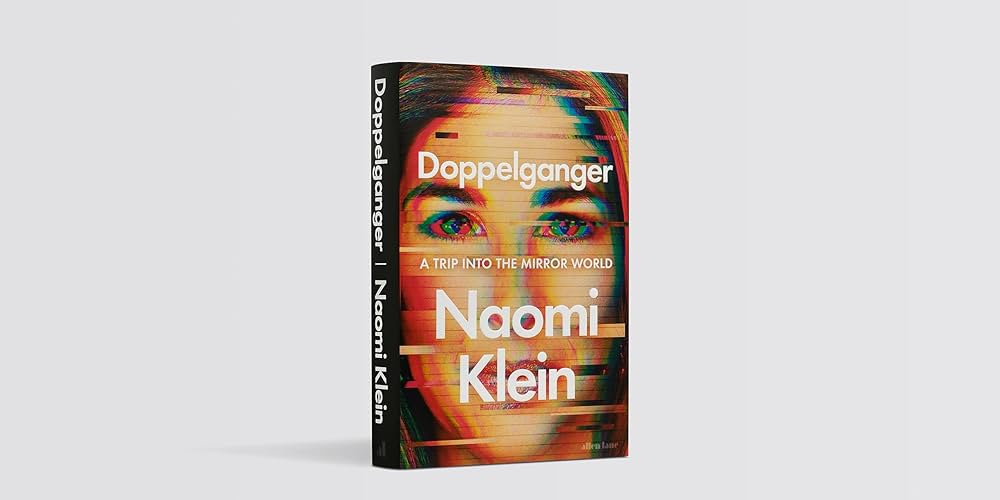
When we think of a conspiracy theorist, we think of tin foil hats and hidden bunkers. Yet in the age of mass media, even the most erratic conspiracy theories can catch wind, resulting in an alarmingly high number of theories and theorists. Naomi Klein explores this concept in a refreshingly contemporary fashion in her 2023 nonfiction book Doppelganger: A Trip into the Mirrorworld. According to Klein, it might serve us to recognize that the root of these increasingly strange theories is isolation.
Naomi Klein is a celebrated political activist and author. She is best known for her books No Logo and The Shock Doctrine, both of which criticize capitalistic exploitation. Her most recent work, Doppelganger: A Trip into the Mirrorworld, is a memoir slash nonfiction political analysis. The book attempts to unwind the workings of the major events of the last decade or so.
The book questions the boundaries between leftist socialism, conspiracy theories, and capitalism. Klein identifies how so many ideologies, even opposing ones, often use the same framework, the same language, and are based on the same fears or desires. They are reflective of one another, hence her use of the term “doppelganger.” In fact, Klein was inspired by a political doppelganger of her own: Naomi Wolf.
Naomi Wolf is a feminist author turned conspiracy theorist. She spread anit-vax sentiments and misinformation during the COVID-19 pandemic. Klein spends much of her book examining Wolf’s metamorphosis into a conspiracy theorist megastar.
The two frequently get confused with one another in person and online, much to Klein’s dismay.
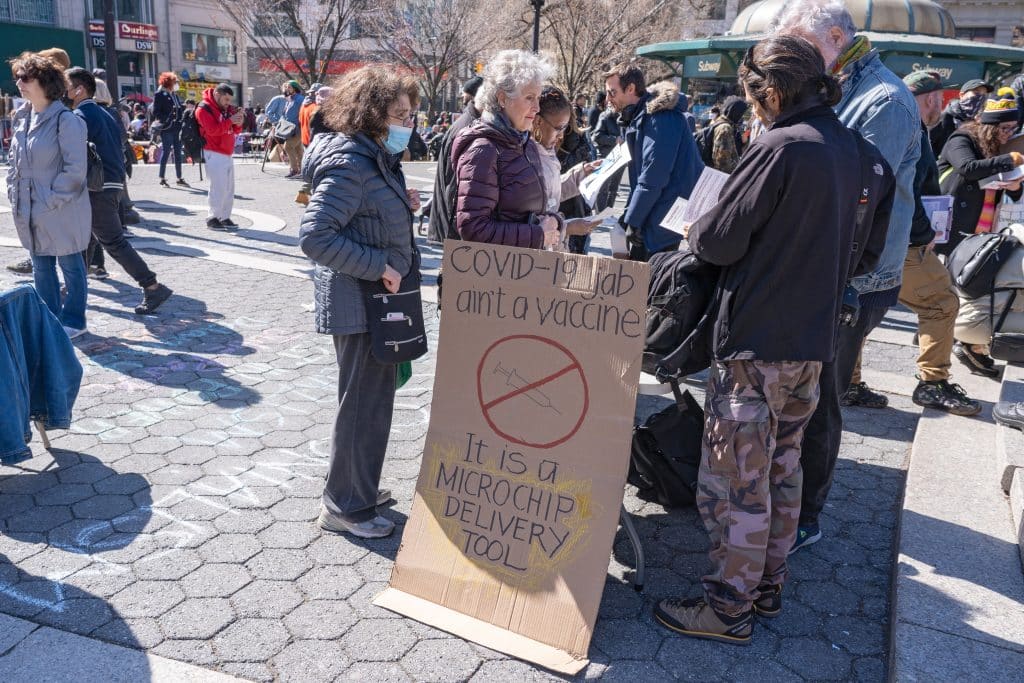
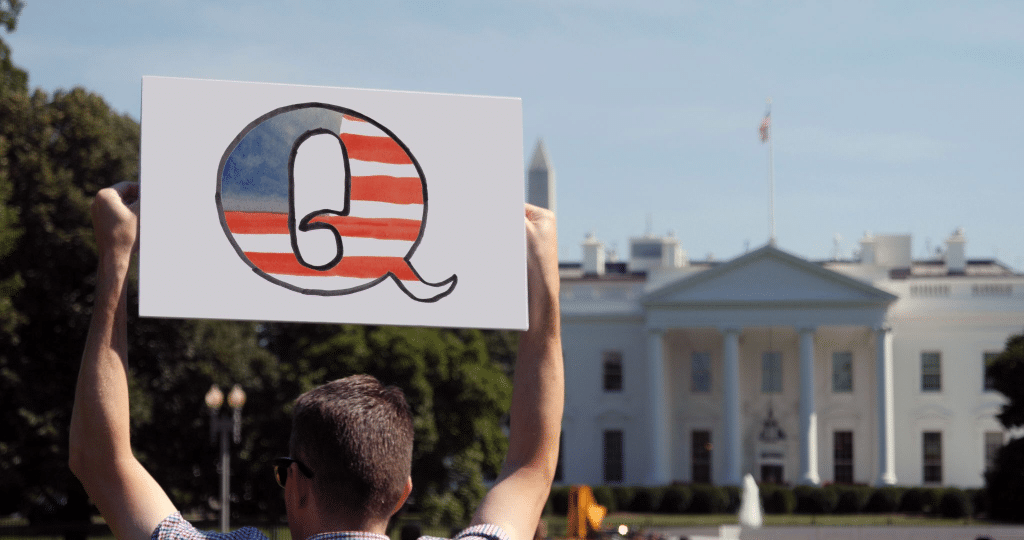
In Doppelganger, Klein narrows her focus to a few major events that have produced modern conspiracy theories. These include the COVID-19 pandemic and the consequent peak of “QAnon,” a far-right political movement kick-started by an online 4chan user named “Q.” The pandemic saw an overwhelming surplus of online discourse. Theories rose about the truth behind the virus. The vaccine is a microchip, an experiment on us, an attempt at eugenics, the list goes on. There were too many to keep track of. Yet they all, Klein observes, have a central drive of fear and distrust.
I am the main character
Klein sheds, for a moment, the face value of these conspiracy theories. To understand the public’s susceptibility to them, she devotes a section of her novel to anticapitalist beliefs. To her, capitalism is the root of fractured senses of community among Western societies. Capitalism sold us the dream of meritocracy. It didn’t matter where you came from or what you started with; if you worked hard enough, then you could have it all.
Not many of us feel like that now, let’s be honest.

It no longer matters how hard we work, nor how entrepreneurial or educated we are. The capitalist system is rigged against the 99%. We are monetary units, consuming for the sake of the rich while we fight our culture wars down here in the streets, and we’re angry about it. How can we not feel there is some nefarious, hidden conspiracy working against us? Making us feel as if all our struggles are our personal moral failures, and not the consequences of an overtly exploitative system? Everything is about us, what we’re doing and failing to do, creating an extremely hyper-individualist culture.
Now, combine the overwhelming feelings we are struggling to grasp with our addiction to interaction through the screen. There is an intrinsic element of inauthenticity in the way we use social media. We pick and choose the best parts of ourselves to share, never having to reach beneath the surface level.
Yet ironically, social media has created a consuming demand for highly original and authentic content. More and more content that now everyone can produce. Everyone can sell their everyday life as entertainment. Consequently, everyone feels the pressure to live their actual lives as if they were entertainment. Influencers churn out mottos like “I’m the main character” and aesthetic labels like “clean girl” and “soft girl,” all aiming to sell us pre-made identities for our picking. You are the product now, but also the consumer. You must be perfect and totally “real” at the same time. It’s a brutal oxymoron.
When these echoed identities are all we ever interact with, it’s a recipe for a disjointed community. A fractured, impersonal ghost of a community.
However, social media has been around for over two decades now, and capitalism much longer. We have become desensitized. Catching someone’s attention can be incredibly difficult. It takes more drastic measures — more absurdity, more irony, more of the unknown, resulting in the acceptance of increasingly bizarre realities.
Klein understands that because so many large corporations are constantly vying for our attention with exhaustive, eye-grabbing media, the truth can never be simple; it is something obscure and difficult to uncover. It is a conspiracy.
“Nothing is as it seems. This kind of predatory, extractive capitalism necessarily breeds mistrust and paranoia.”
Take Bill Gates’ funding for distribution of the COVID-19 vaccine. The internet responded with immediate suspicion. Too many people were incapable of believing that something so important could be given to us for free.
Klein observes that the pandemic forced us to do what capitalism disdains: Rely on each other. Becoming aware of our hyper-dependence rather than our hyper-independence. That was simply too much for some.
I need a hero
So the pandemic (and corporate capitalism) has left us isolated, worn down, and afraid. In comes QAnon. The most famous QAnon conspiracy theories concern “pizzagate” and the general “Deep State.” QAnon asserts that there is a secret, all-powerful group of pedophilic satanists (they name-drop figures like Hillary Clinton and Barack Obama) running child sex trafficking rings and controlling the U.S government — and they’re doing it out of the basement of a pizza parlor.
QAnon, to most nonbelievers, is absurd.
Klein does point out some harsh ironies in the theory targeting Democratic figures when Donald Trump, QAnon’s proclaimed messiah, has multiple sexual assault allegations and is a known associate of Jeffrey Epstein. Yet she maintains that the emotional outbreak sustaining QAnon is the dangerous consequence of issues we all face.
Klein self-identifies as a leftist. Yet her “mirrorworld” metaphor is a prod to evaluate the behaviors of both the “right” and “left” political parties as she recognizes the flaws of her own party. One such flaw is the self-righteousness that the left parades over the “absurdity” of the right. If anything, these outlandish theories are far more reflective of the actual emotional state of the world than the left’s rationality. While the left uses cold, hard facts to bear through difficult situations, the right disregards actual evidence concerning current events in favor of an emotional outlet. The issue, Klein emphasizes, is that as much as the left likes to promote tolerance, they also tend to mock their opponents, and mockery can be an effective repellent.
“On the democratic socialist left, we favor social policies that are inclusive and caring – universal public healthcare, well-funded public schools, decarceration, and rights for migrants. But left movements often behave in ways that are neither inclusive nor caring.”
Capitalism taught us that failures must be the result of people, not structures. It must be Hillary Clinton’s fault. It must be Barack Obama. Or Bill Gates. Because in a world where everything we have must be earned through our blood, sweat, and tears, kindness cannot come for free. But how do you bring down a structure? Targeting a concept is much more difficult than targeting just a few people. In that sense, QAnon offered a scapegoat; a deliciously easy one — and it offered a space where you would not be ridiculed for it.
Yes, conservatives and right-wingers often support less inclusive policies. They lead to anti-immigration sentiments and ostracize different cultural practices. But Klein’s Doppelganger aims to ask the question: Is mockery really the best way to react? Instead, we must be better teachers if we truly want to create a more unified community.
The birds work for the bourgeoisie
Klein is not the only one who advocates for compassion over contempt. In 2016, a man named Peter McIndoe began a movement called “Birds Aren’t Real.” The movement was born by accident out of a chaotic women’s rally when McIndoe spontaneously held up a sign saying “Birds Aren’t Real.” When asked what it meant, he improvised. He claimed that the US government had killed all birds and replaced them with surveillance robots.
McIndoe, in an NPR article, shares insight from his experience spearheading the fake movement. He shares the intense criticism he received from those who found his theory absurd. The commentary left him feeling dejected. It made him more resolute in defending the theory rather than encouraged to have real conversations with those in disagreement.
McIndoe aimed to bring people together using the comedic relief of the movement. Noticeably, many of the Gen Z groups he met responded positively to his silliness. He explained how he grew up in a hyper-conservative environment and how he feels that he understands what leads people into believing conspiracy theories: the feeling of safety and purpose in a small group against the harsh criticism and greater isolation of the rest of the world.
You can’t have your cake, and eat it too
Klein frames her novel with a comparison between herself and her public-facing doppelganger, Naomi Wolf.
Yet, Klein let her quarantine-induced infatuation with Wolf instead inspire a newfound compassion. She analyzes how and why the once liberal political figure shifted so drastically into the conservative sphere. Klein identifies multiple points throughout the book. However, the main event she cites is a particularly brutal 2019 BBC interview in which Wolf was publicly shamed on live television for making a crucial misinterpretation written in her book Outrages.
Klein remarks that “if you want an origin story, an event when Wolf’s future flip to the pseudo-populist right was locked in, it was probably that moment, live on the BBC, getting caught – and then getting shamed, getting mocked, and getting pulped.”
Klein’s perspective is key in building compassion for those opposing us, even if it may be draining. When we develop a habit of shaming or ridiculing those who have different beliefs, we push them further from the truth we want them to see. We become the “other,” and that ultimately tightens the circle, fortifying the community conspiracy theorists build together.
“A more accurate description is that Wolf marched over the edge and was promptly caught in the arms of millions of people who accept every one of her extraordinary theories without question, and who appear to adore her.”
So, although it may be a satisfying outlet for our own frustrations, we can’t revel in holding intellectual and moral superiority over everyone if the true goal is to get them to see what we do.
We can’t have our cake and eat it too.