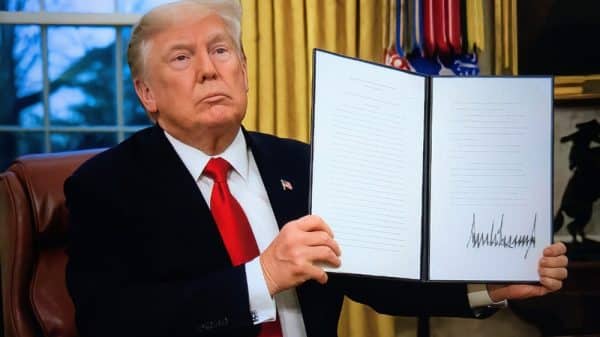
Last month, The Atlantic published an article entitled “Trump’s Right-Wing Socialism.” The piece made specific reference to Trump’s authoritarian overreach into the domain of private institutions, including media outlets, universities, and law firms.
In the light of this article, several broadcast programs and public figures have used the term “socialism” to describe Trump’s economic interventions. For example, host Joe Scarborough on MSNBC’s Morning Joe and Democratic California Governor Gavin Newsom.
Even fellow Republican Senator Rand Paul from Kentucky has described Trump taking “a step towards socialism.”
On Monday, former presidential candidate Kamala Harris compared Trump to a “communist dictator.”
Publications have phrased it in a myriad of ways: Fortune suggests that “MAGA has gone Marxist and even, increasingly, Maoist.” The Free Press offers this headline: “Trump Seizes the Means of Production at Intel.” Finally, two New York Times articles accuse Trump of an “assault on capitalism” and refer to the president as “comrade.”
The most cited action in this “socialism” narrative is Trump’s acquisition of a 10 percent stake in tech corporation Intel. It’s curious—at least, to me—that this is the case.
The Atlantic’s aforementioned article made a point of Trump’s turn toward so-called “big government,” but this argument is hardly limited to the economic sphere of private industry.
The Trump administration has been scaling up the punitive functions of government for a while now. A primary example is an increasing investment in Immigration and Customs Enforcement (ICE), which I wrote about just weeks ago. Another would be Trump’s frivolous threats to deploy the National Guard across the country.

However, my main focus here is on the phrase “right-wing socialism.” It’s certainly an evocative choice of words, whether for its fearmongering or the ideological contradiction it presents. It also raises a number of questions.
Wait, isn’t socialism left-wing?
Within the larger media discourse about Trump, there’s a final use of the term “socialism” that I neglected to mention. This time, it was in conversation with a figure that would seem to be Trump’s polar opposite: democratic socialist Zohran Mamdani.

In an interview with CNN’s Abby Phillip, Mamdani was asked if he and Donald Trump were similar in an alleged affinity for socialist policy. (Mamdani replied: “I don’t think there’s much that Donald Trump does that can be understood through … ideology.”)
But, bringing in self-proclaimed democratic socialists meaningfully complicates the media’s attribution of this label to Trump.
Some of the most nationally popular Democrats—especially when the Democratic Party as a whole has been polling near its weakest—are affiliated with socialism. For example, Senator Bernie Sanders and Representative Alexandria Ocasio-Cortez.

The rising popularity of socialism isn’t just attached to big names, either. Recent polling shows that socialism is gaining favorability broadly among Democrats and the youth.
A recent Gallup poll finds that 66 percent of Democrats have a positive view of socialism. There’s a similar trend for young Americans. Nearly two-thirds of Americans aged 18 to 29 view socialism favorably, according to a 2025 YouGov/Cato poll.
Of course, the elephant in the room is the haziness of what underlies the term “socialism” in the American imagination.
Based on any number of external influences, we understand Trump as generally right-wing. In a similar way, we may collectively understand policies of state economic intervention as “socialist.” Even if said state intervention is self-serving, not exactly socialized, in nature.
To answer the question of where socialism falls on the political spectrum, we have to understand the ideology’s past and present.
What is socialism, anyway?
Though we can’t hope to gain a complete understanding of the complex history of socialism here, we can discuss it in broad terms.
Socialism, in the simplest historical sense, is a rejection of capitalism and the labor relations between workers and owners present within capitalism. It rejects the valorizing of profit and private ownership as a system of social, political, and economic organization. It rejects the idea that workers should be forced to sell their labor to owners—who profit from that labor—to survive.
Depending on the context, socialism can also refer to a transitional state between the overturning of capitalism and the establishment of communism.
Without recounting Karl Marx’s writings in depth, we can come to a few simple conclusions about what this means.
Firstly, socialism isn’t as simple as mere state intervention, whether that’s intervention in the economy or the personal lives of citizens more broadly. It’s not a synonym for authoritarianism, totalitarianism, or dictatorship. It’s the political opposite of truly right-wing fascism.
This isn’t to say that you have to agree with socialism. You may very well prefer capitalism. But, we cannot simplify socialism to government ownership or interference in business and the economy. We cannot draw a conclusion by solely observing the means, while completely ignoring the ends.
Socialism requires labor relations which exclude the current dynamic of distinct separation between worker and owner. Consequently, “state-run” doesn’t mean “socialist.” Not when “state control” doesn’t entail democratic worker ownership and control over their labor, as well as the conditions it occurs in.
Paralleling how today’s media focuses almost exclusively on interactions with private industry, this contemporary American definition of socialism ignores the conditions of the worker entirely. This includes the worker who can be stopped, and now legally racially profiled, by ICE. This includes the worker whose city can be occupied by the National Guard.
The definition I’ve put forth of socialism may seem unfamiliar, given the widespread American narratives about socialism and communism. But, it isn’t exactly new. Not even in the US. Here, too, socialism has a storied history.
A brief history of US socialism
The work of socialist thinkers like Marx was never confined to Europe. As soon as people read and resonated with socialist thought, they transformed this theory into action in the US.
Socialists participated in the earliest labor organizing, advocating for better working conditions and objectives like an eight-hour workday. One union leader, Eugene Debs, even ran for president in 1920 as a socialist candidate and won nearly one million votes.
In response to the Great Depression, the New Deal era also represented some bounds for US socialism. Again, socialists helped to organize and mobilize people to demand government action. After all, it was only in the 1930s that the first federal minimum wage was established. Socialists have also advocated for policies found in today’s most popular government programs, such as Social Security.
Now, to the socialist history we are more familiar with: the Red Scares. Indeed, multiple. The onset of the Cold War in the 1940s brought the best-known scare. Government repression and anti-communist fervor reached their peak as prominent figures like Republican Senator Joseph McCarthy spread hysteria. This led to intense FBI and congressional investigations, firing and blacklisting, and even the imprisonment of communists in the 1950s.
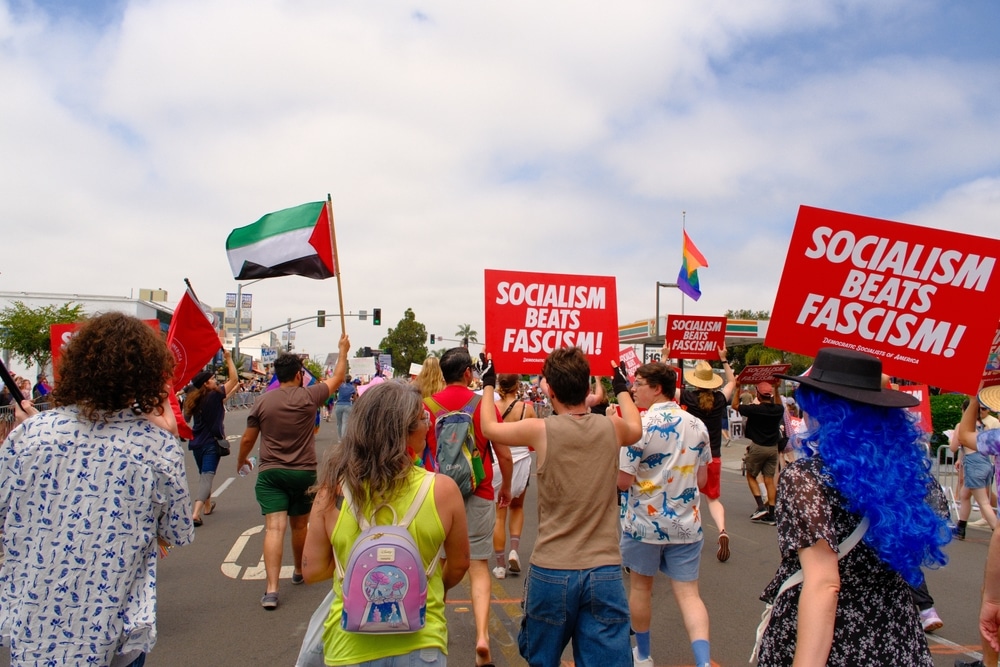
Today, organizations like the Democratic Socialists of America (DSA) and the Party for Socialism and Liberation (PSL) carry this history forward.
Then, how is Trump a socialist?
To finally answer the question definitively: He isn’t one. If Trump seized Intel and redistributed the wealth or socialized the labor relations of the company, that might be something closer to actual socialism. But, merely seizing a corporation to concentrate wealth and power within a far-right government seems more like kleptocracy.
When a government like Trump’s merely takes the place of a private owner of a capitalist business such as Intel, it definitionally cannot be socialist. The labor relations present in capitalism aren’t disrupted. Ownership remains private, not becoming collective or socialized.
As it stands, Intel remains a for-profit corporation that Trump can attempt to coerce however he pleases. If anything, the whole Intel debacle is just a thread in the seemingly-endless tapestry of Trump’s fascism. (That fascism has been most recently exemplified by Trump’s attempt to designate the decentralized anti-fascist, or Antifa, movement as a domestic terrorist group.)
In Trump’s threats to universities, we can see a capitalist-adjacent logic: The price of the government providing a public good is a form of profit for Trump. What is that form of profit? Total compliance. Obedience buys access to federal funds in a process that only continues to valorize profit and private ownership.
Instead of socialism, state capitalism and corporatocracy may be more representative of this administration’s pro-profit and pro-private ownership views.
Like almost every Republican, Trump is virulently anti-socialist and anti-communist, often accusing Democrats of advocating for socialism or communism. And, if we’re going to place him somewhere on the left-right spectrum, he is infinitely closer to fascism than socialism.
America and lost ideology
Socialism is hardly the only political philosophy to change in colloquial meaning over time. For example, the tide of history has transformed liberalism, too.
Classical liberalism of the past might be almost unrecognizable to many who claim the label today. It originated in strong support for private property and ‘free market’ ideals, with faith in Adam Smith’s ‘invisible hand.’ Now, American liberalism is widely associated with a preference for the increased availability of welfare and social services.
American politics have reconfigured and redefined ideologies of all sorts throughout our history. They’ve misappropriated political philosophies in response to history’s victors: the successful ideological proponents who rationalized their ideas and disparaged those of their opponents.
In the case of Trump and socialism, we do ourselves a disservice by not describing these political features as what they truly are, by ignoring the history that creates each of them. It’s critical that we can recognize what different political systems actually look like.
The problem of ideological inconsistency is nothing new, but this constant watering down of political language impairs our ability to diagnose reality. It advances the limiting idea of politics as a team sport, rather than a constructive exercise in thinking creatively and critically.
When we miss historical nuances, we stall our own discourse. We discourage conversations about the true merits and deficiencies of our different visions.
Evidently, our knowledge of history faces enough attacks as it is. Just recall Trump’s recent remarks about the Smithsonian and its apparently too-heavy focus on ‘how bad slavery was.’ But, we need to understand our political past—or, at minimum, show some curiosity and humility regarding it—to produce a worthy future.
As a political science major myself, I feel strongly about the value of political education. Especially when that political education falls outside of the mainstream. In the current moment’s feeling of stagnation, it’s more important than ever that we do what we can to expand our political possibilities.