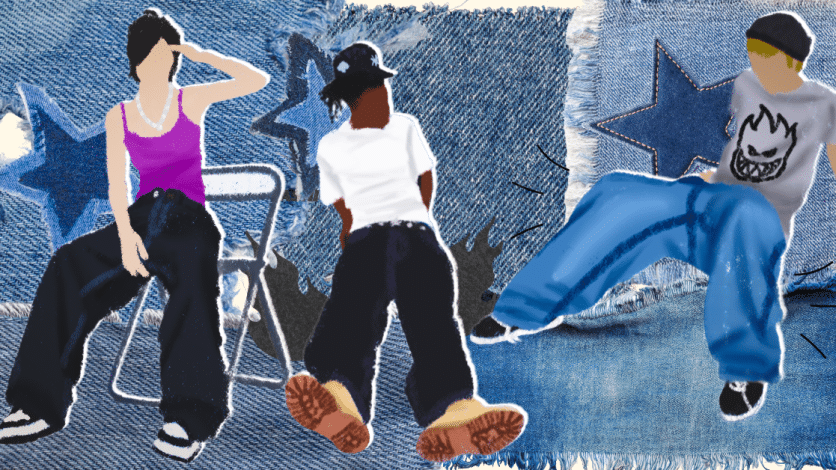
Baggy jeans have ruled the fashion mainstream for the past few years, but like every trend, their moment eventually fades. At the start of the 2020s, skinny jeans began slipping out of favor as streetwear leaned toward straighter silhouettes. The revival of 90s and early 2000s style only accelerated the shift, pushing baggy denim into the spotlight as the go-to choice for the masses. Now, after riding a wave of peak popularity, signs suggest that baggy jeans are approaching the final stage of their trend cycle.
And one of the easiest ways to spot a trend in its final stages is…
Baggy jeans are landing in mall retailers
In the fashion cycle theory, one of the signs that a trend is coming to its end is when it is fully commercialized, shows up in mall stores, fast fashion sites, and is widely mass produced.
Taking a look at where trends are being sold at offers heavy incite into where the style is.
Mall stores like Pacsun, Zumiez, and Cotton On are mass-market retailers that thrive on catching trends at their peak and churning them out for the mainstream. When a style reaches these shelves, it means it has already cycled through subcultures, influencers, and niche markets. And now it is accessible to everyone. This accessibility is a marker of the trends success, as well as a marker of the trend losing its exclusive edge.
As for the baggy jeans trend its precense in these mall retailers signals it has reached mass adoption. What started as 90s and Y2K revival has become a staple of mass production, hanging on racks next to graphic tees and hoodies.
However this doesn’t mean baggy jeans will vanish, as denim trends tend to stick around for longer than micro-trends, it does suggest that their cultural peak has passed. From here the trend continues to oversaturate and consumer begin looking for the next fresh trend.
But the baggy trends reach hasn’t just been about jeans.

Baggy everything
The adoption of baggy jeans by the mainstream created a wider demand for “baggy” across the board.
This silhouette didn’t stop at denim, it carried over into track pants, dress pants, shorts, and even sweat pants. In today’s fashion mainstream, proportions have become a central talking point, and one of the simplest ways to balance proportions is by going bigger on the bottom.
That doesn’t mean “good” proportions are exclusive to baggy fits, skinny jeans and slim styles can also be worn proportionally well, but baggier cuts tend to make it easier for an outfit to flow and feel intentional.
As people realized that baggy jeans made it easier to create balanced proportions, other types of pants quickly followed.
One of the clearest examples is sweatpants. For years, they were almost always tapered at the bottom, sometimes tightly, sometimes more loosely, but always with that narrowing shape. In the past few years, though, that has completely shifted. The most sought-after sweats are now baggy, wide-legged, and loose-fitting.
Brands found plenty of success by borrowing the silhouette of baggy jeans and applying it to sweats. It makes sense: baggy fits offer better proportions, align with the current trend cycle, and have become a major talking point in fashion.
Today, baggy cuts dominate everything from track pants to dress pants, and they’re all hanging in mall stores, proof that “baggy” has gone fully mainstream.
But if the baggy trend has gone fully mainstream and entered the late stage of its cycle, then what comes next? What actually happens to baggy when a trend begins to decline?
Baggy at its breaking point
The truth is, baggy isn’t disappearing. There will always be people who prefer a certain cut of pants no matter what the mainstream declares “in.” Even today, during an era defined by anti-skinny jeans, there are loyal consumers who still swear by them. The same will hold true for baggy when its trend cycle fades.
For the mainstream, though, oversaturation is hard to ignore. Once you can buy the same silhouette of baggy jeans from Balenciaga, PacSun, and Shein, the style has reached peak commercialization. At that point, baggy is no longer a statement, it’s the default. And in fashion, when something becomes the default, its decline has already begun.
We’ve seen this play out before. Skinny jeans, once the epitome of cool, were elevated by designers like Hedi Slimane at Dior Homme, whose ultra-skinny cuts reshaped menswear, and Alexander McQueen, whose provocative “bumsters” redefined how trousers fit on the body. These high-fashion silhouettes set the stage for what became the defining denim look of the 2000s and early 2010s, until the same styles trickled down to mall retailers and fast-fashion chains, stripping them of their edge.
Baggy jeans are now at that same point. Their widespread availability doesn’t take away from the craftsmanship or design behind them, but it does strip away exclusivity. And in a fashion world obsessed with what’s rare, fresh, and next, once a style becomes too accessible, the industry inevitably pushes forward, searching for the silhouette that will define the next wave.
With that being said…
What’s next for denim?
Fashion trend analysis is no exact science, but one useful framework is the fashion pendulum.
The pendulum swings styles back and forth over time, but it never moves from one extreme directly to the other. Instead, the shift happens gradually. For example, the downfall of skinny jeans didn’t immediately make ultra-baggy pants the dominant style. First came slim fits, then mom jeans and straight cuts. Only after that steady widening did baggy and ultra-baggy silhouettes take over.
That brings us to where we are now: baggy and ultra-baggy denim dominating the mainstream. But as we’ve seen, the trend is entering its final stage. Which raises the question — where does denim swing next?
That’s what I am here to answer.
I think denim will swing slightly back, with cuts like flares and bootcuts leading the next wave.
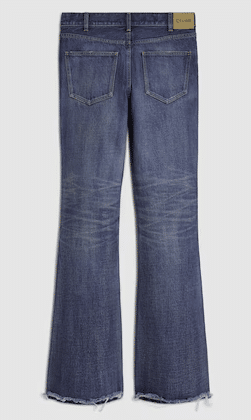
There are a few reasons for this. First, flare and bootcut styles are still generally loose-fitting, but they create a more shaped silhouette than ultra-baggy jeans. Second, streetwear has recently begun blending with formalwear, collared shirts, blazers, and ties are making a comeback. While baggy denim works with this look, bootcut and flare jeans complement it just as well, if not better. Also, flares and bootcuts offer versatility when it comes to proportions (again a heavily talked about piece of fashion right now). Finally, because flares and bootcuts have been out of the mainstream cycle for some time, they carry a sense of scarcity and exclusivity that makes them feel fresh again.
Footwear is another factor in shaping denim trends. Sneakers and sandals have cooled off, while boots, loafers, and oxfords are dominating right now. This shift toward more polished shoes naturally pairs better with denim that leans formal.
Bootcut and flare jeans deliver that slightly more refined edge. Baggy fits still have their place, but these styles offer a dressed-up alternative that aligns with where the broader fashion pendulum is swinging.
From here the bigger picture becomes clearer. Baggy, skinny, or anything in between, denim trends aren’t about changing silhouettes overnight, its about a constant push and pull shaped by culture, trends, and what feels new.
Baggy jeans won’t disappear entirely, they’ll remain a staple for certain subcultures and everyday wear, but their reign as the defining trend is ending. Bootcut and flare jeans are positioned to take that spotlight, blending the comfort of looser fits with the polish that modern streetwear is gravitating toward.
Which brings us back to the original question: Are baggy jeans going out of style? The answer is yes, but only in the sense that their cultural peak has passed. They’ll remain part of the denim conversation, but the pendulum is swinging. As fashion continues to balance casual and formal, exclusivity and accessibility, it’s the shaped silhouettes of bootcut and flare jeans that look poised to define the next chapter of denim.
But what do you think, do you think baggy jeans reign is ending? Do you think bootcut and flares will have the spotlight next?