
Britney vs. Christina. Taylor vs. Katy. Even Rihanna vs. Cierra. These feuds gave fans someone to root for, someone to root against, and endless fuel for stan wars.
When Olivia Rodrigo dropped “drivers license” in 2021 and all signs pointed to Sabrina Carpenter as the other girl, the internet did what it does best: it built a rivalry overnight. Olivia was the heartbroken one; Sabrina? A home wrecker who stole another girl’s boyfriend.
But here’s the twist: instead of tearing each other down, both artists carved out their own corners of pop. They became two of the genre’s defining voices.
Olivia leans into melodrama — like a diary entry written in bold Sharpie and all caps, while screaming at the top of your lungs.
Sabrina plays with irony and flirtation — the wink across the room, the punchline that hides a deeper truth.
Together, they’re less rivals and more reflections of each other. They are two artists proving that heartbreak doesn’t just have one sound, one face, or one way of surviving it.
The origin
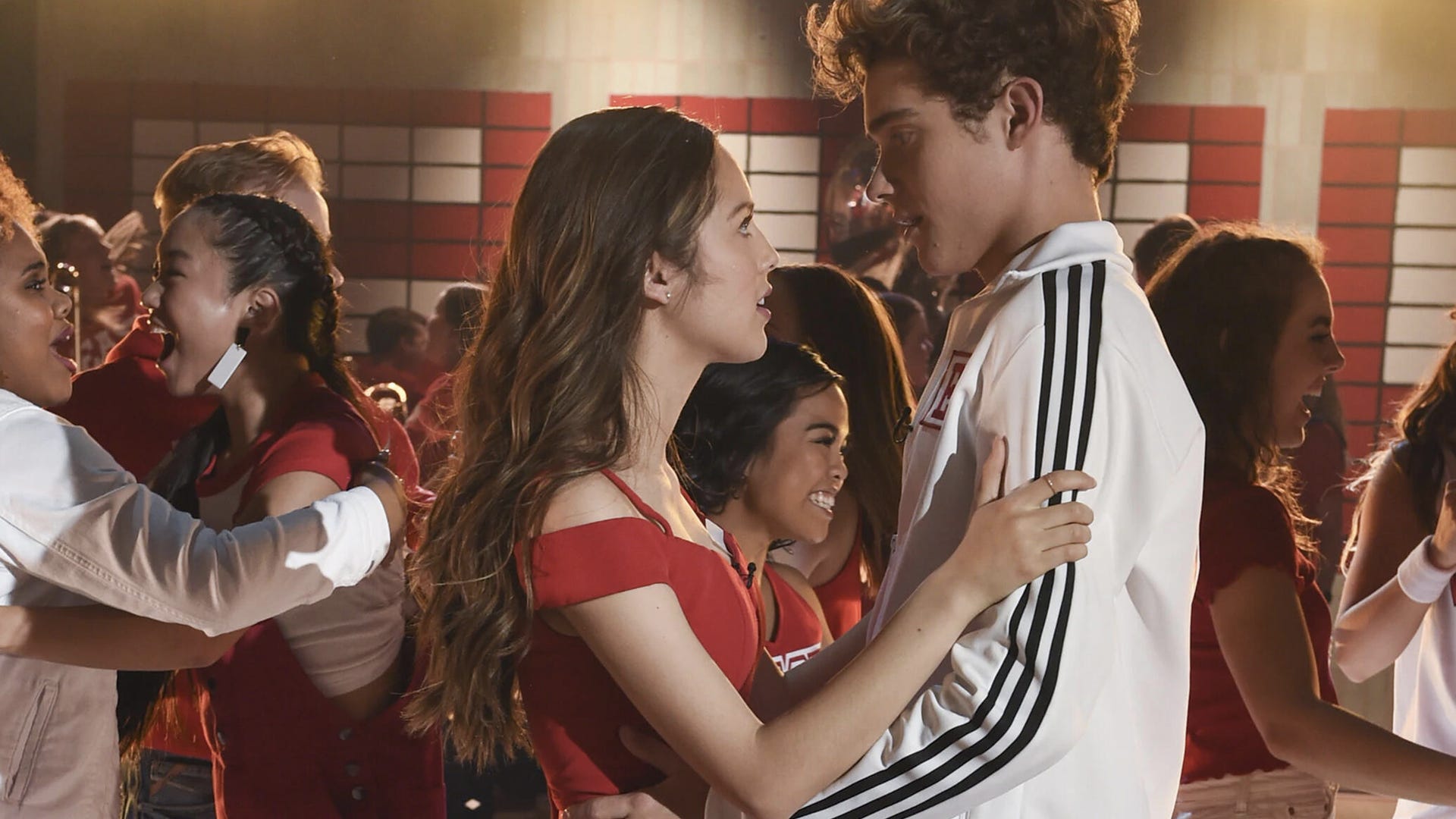
Before they were pop’s newest powerhouses, Olivia Rodrigo and Sabrina Carpenter were Disney girls — though they played very different roles in different eras of time. Olivia starred as Nini in High School Musical: The Musical: The Series.
Sabrina, on the other hand, rose to fame as the sharp-tongued Maya Hart in Girl Meets World, a revival of the iconic Boy Meets World. She was the rebellious best friend and classmate of Rowan Blanchard’s Riley Matthews.

They exploded into mainstream consciousness in early 2021 with the release of Olivia’s debut single, “Drivers License.” The song, instantly viral, told the story of how she’s gutted by heartbreak. She watches the boy she loved move on with someone “older, blonde.” As Olivia sang:
“And you’re probably with that blonde girl
Who always made me doubt
She’s so much older than me
She’s everything I’m insecure about.”
The narrative only intensified when Sabrina and Joshua shared a TikTok of the two goofing around on Halloween together. The internet’s verdict was swift. Fans didn’t have to squint hard to connect the dots. Olivia’s HSMTMTS co-star Joshua Bassett, her rumored offscreen boyfriend, had moved on with Sabrina Carpenter.
Sabrina’s subsequent single, “Skin,” fueled the fire even more, with pointed lyrics that seemed to respond directly to Olivia’s heartbreak:
“Maybe we could have been friends
If I met you in another life…
Maybe you didn’t mean it
Maybe blonde was the only rhyme…”
What could have been dismissed as teenage drama ballooned into one of the most dissected pop triangles of the decade.
The confessor and the trickster
Olivia’s debut, SOUR, cemented her as Gen Z’s heartbreak poet laureate. Songs like “traitor” and “enough for you” captured the ache of betrayal with full-throttle pop-punk. On her follow-up GUTS, Olivia expanded that palette but kept the diaristic core — the confessions just got sharper, messier, funnier.
Tracks like “love is embarrassing” and “bad idea right” feel like pages ripped from a journal. “Get him back!” channels rage into a chant you want to scream in the car with your best friends.
Sabrina, meanwhile, approaches the same subject matter from a wryer angle. On emails i can’t send and last year’s Short n’ Sweet, heartbreak isn’t something she just suffers through. It’s something she teases, mocks, and remixes into spectacle.
Where Olivia spirals, Sabrina shrugs and smirks. “because i liked a boy” flips scandal into sly commentary, while “please please please” turns vulnerability into a viral sing-along.
Even in her softer moments, Sabrina tends to wink, turning self-defense into art.
Parallel aesthetics – contrasting but connected
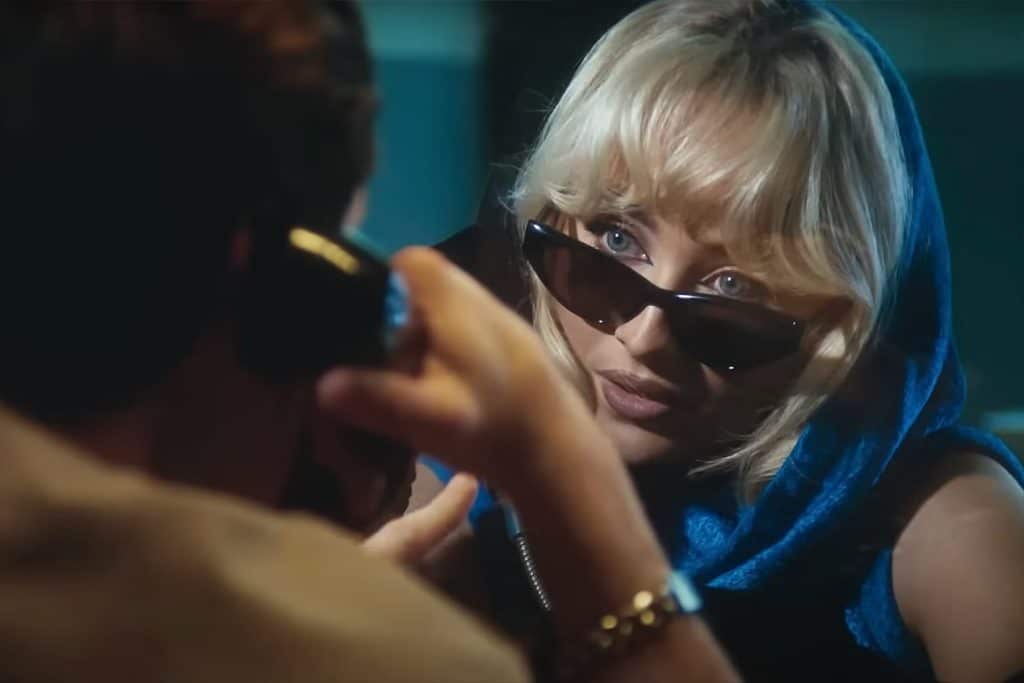
What once began as a supposed feud has transformed into something more interesting. Ultimately, Olivia Rodrigo and Sabrina Carpenter operate less as rivals and more as a duo working separately but in sync.
Olivia’s GUTS gives fans the raw purge of emotions. Sabrina’s Short n’ Sweet offers the sly, playful afterthought — the “what now?” to Olivia’s “how could you?” What started as a supposed feud has evolved into a fascinating dynamic. Olivia Rodrigo and Sabrina Carpenter operate as a duo, each telling a different side of the heartbreak story.
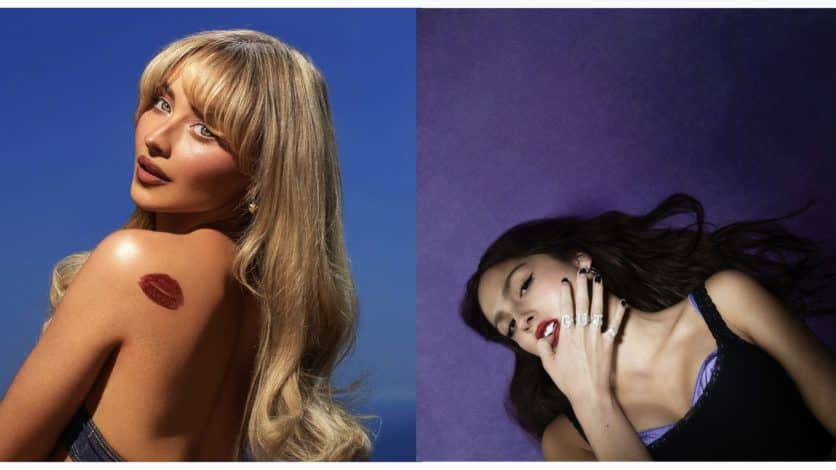
Her GUTS era is ruthless chaos, with album art, stage design, and performances steeped in bold purples. There is dramatic stage presence and a sense of emotional exposure. Listening to Olivia is like reading someone’s diary aloud: jealousy, rage, heartbreak, and insecurity laid bare. Listeners are in the headspace of someone unraveling from love, offering an outlet for pure emotional rage.
Sabrina, by contrast, frames heartbreak through playfulness and wit. Short n’ Sweet is a candy-coated exploration of love’s ups and downs. The smirks, the side-eyes, the moments of vulnerability balanced with cheeky confidence. Choosing to flirt and tease or move on with humor. Her visuals, from bubblegum-pink album art to southern belle style, turn pain into playful resilience. It’s a wink across the room at the mess you’ve endured.
If Olivia and Sabrina’s music represents two sides of heartbreak, then their visuals tell the same story in color and costume. Moreover, this duality reframes the supposed “rivalry” completely. Instead of competing for hearts or popularity, they’re giving fans complementary perspectives. Rather, they’re giving fans two lenses through which to explore love’s highs and lows.
Beyond the rivalry – the future of pop
The cultural obsession with pitting women against each other has long shaped pop narratives. Olivia Rodrigo and Sabrina Carpenter show that the story doesn’t have to be a battle. Rather, instead of competing for the same lane, they coexist. Each tells a distinct side of heartbreak and self-discovery.
Olivia channels the raw, confessional meltdown, while Sabrina presents heartbreak with charisma. Together, they create a fuller emotional spectrum that fans can inhabit, making the “rivalry” narrative feel outdated and reductive.
This complementary dynamic sketches the blueprint for Gen Z stardom. Both artists harness social media, streaming, and visual storytelling to craft personas that are emotionally authentic yet highly curated.
Their coexistence proves that modern pop doesn’t require conflict to drive engagement; it thrives on contrast, diversity, and duality.
Fans can scream with Olivia, smirk with Sabrina, and experience the entire spectrum of love, loss, and resilience. In doing so, the duo not only redefines heartbreak in pop music but also models a new era. In this era, women aren’t forced to compete — they can rise together, separately, and on their own terms.