

Fashion’s obsession with the past has never been more literal.
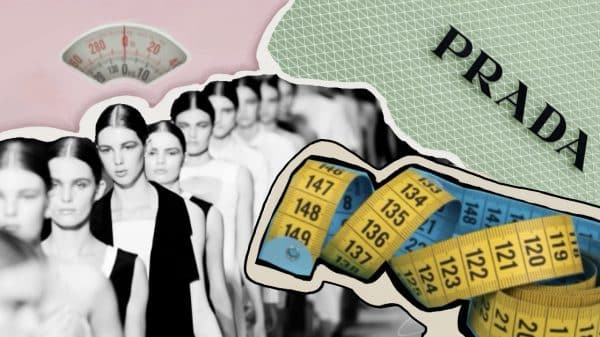
In Prada’s Fall/Winter 2025 campaign, Kendall Jenner walks forward clutching a black leather bag. The light is flat against a white background, the set is stripped of ornament. Around her, faces are blank, models caught mid-stride. Everyone looks suspended, as if a button has been pressed on a VHS player. It could be 1998, it could be 2001, it is in fact 2025.
This is not a subtle nod to the past. It is a recreation. The new campaign mirrors the cool detachment of Prada’s late-90s image-making almost exactly, right down to the frozen motion and empty backdrop. In another time, a fashion house might have used an old campaign as reference material, twisting it into something new. Now the instinct is to lift it whole, polish it, and present it as current.
Fashion has always circled back on itself. Hemlines drop and rise again, silhouettes swell and shrink. But the present cycle feels more rigid. The ouroboros, the snake consuming its own tail, is no longer a mythic idea about renewal. In fashion it has been absorbed into the way business is done.
The culture of reissue
The practice of bringing back past designs has shifted from occasional nod to constant presence. Prada’s Re-Edition line produces early-2000s nylon bags almost exactly as they were. Fendi has revived the Baguette so many times that the revival itself has become a fixture. Marc Jacobs reissued the Stam bag and brought Jessica Stam back to model it. Dior’s Saddle returned in its full equestrian curve, even in the “Christian Dior Daily” newspaper print. Louis Vuitton released the Takashi Murakami multicoloured monogram exactly as it looked in the early 2000s.
Even couture has joined in. For his first haute couture show at Balenciaga, Demna made a precise recreation of Cristóbal Balenciaga’s 1967 wedding dress with no reinterpretation.
Handbags have become the purest expression of this loop. They sit at the sweet spot of accessibility and prestige. They are cheaper than a couture gown but still expensive enough to mark status. A revived bag is immediately recognisable, tying the buyer to a visual lineage without requiring any history lesson.
Secondhand culture feeds this appetite. Platforms like Depop, The RealReal and Vestiaire Collective have made archive shopping part of everyday fashion language. For a generation raised with this visual vocabulary, owning a piece that reads as “archive” feels like status. When brands produce these pieces themselves, scarcity begins to thin out. A 1999 Jean Paul Gaultier couture dress can reach €377,000 at auction. A reissued 90s Gaultier tattoo-print top sells for £310, new and in multiple sizes.

Capitalism branding and the cost of creativity
For more than thirty years, the same political and economic structures have shaped the conditions of cultural production. The big shifts that once forced change in art and fashion have been rare. Since the 1990s, many of the same companies and cultural figures have held their ground.
Inside this environment, novelty is expected but financial risk is avoided. A new silhouette is expensive to develop and may not sell. A hoodie covered in a recognisable logo is predictable income. This is why ready-to-wear is dominated by monograms, repeat prints, and shapes the customer already trusts.
Designers are hired for their vision but are often steered toward safe territory. Past bestsellers are revived with minimal change. Competitors’ successes are mirrored to capture a slice of the same audience. The safer the design, the more likely it is to make it through the executive filter.
River Quintana calls this “capitalist necromancy”. Old trends are revived to be sold again, stripped of the cultural conditions that made them radical. Walter Benjamin might describe it as a loss of aura, the disappearance of the qualities that make a work unique. Guy Debord might see it as the spectacle, when lived experience is replaced by the circulation of images. In this system, the past becomes a constant source of imagery, stripped from its time and sold into the present.
The result is an endless present dressed in the clothes of the past.
Microtrends and the algorithm
The internet has made fashion history instantly searchable. Search engines, Pinterest boards and Instagram accounts have trained people to recognise specific garments from specific years. A green chiffon dress from Versace’s spring 2000 is instantly known as the Jennifer Lopez dress. Galliano’s Dior newspaper print is identified on sight.
TikTok speeds this up even further. A clip of a runway look can reach millions of people in days. When the garment appears again, whether in original or reissued form, it comes with an instant set of associations. The algorithm rewards familiarity, which in turn drives brands to mine references their audience will know at first glance.
The speed is destabilising. Fashion cycles that once stretched over a decade are now compressed into weeks. Microtrends appear, burn bright for a month, and are replaced. The only constants are the archive references – images that can be recycled indefinitely.
When Versace brought back Jennifer Lopez’s green jungle dress in 2019, it was a calculated viral moment. The dress had already lived in pop culture memory for nearly twenty years. Seeing it again on the same body was designed to trigger instant recognition. It worked. It was also a sign of how reluctant fashion is to let its most bankable images rest.
Are there any new ideas?
Copying is as old as modern fashion itself. Coco Chanel called it the “ransom of success”. In the late 19th and early 20th centuries, buyers would send sketchers to Paris shows to copy designs for other markets. American stores often did this without permission. Madeleine Vionnet went so far as to stamp her thumbprint on garment labels to guard against copies.
Economist Thorstein Veblen described copying as a core function of fashion, changing designs just enough to push last season into obsolescence. What has changed now is the visibility and speed. A copy can be spotted online within hours of a runway show.
Small designers are especially vulnerable. Their work can be replicated before they have built the recognition to defend it. Larger houses face less risk, but the safest path for them is still repetition. The word “new” is often used in marketing to describe a garment that is structurally identical to something from five, ten, or twenty years ago.
Breaking the loop
There have been points in recent history where fashion managed to break away from its own orbit. The Antwerp Six challenged how collections were presented and understood. Alexander McQueen’s work in the 1990s reshaped ideas about beauty and theatricality. Jean Paul Gaultier pushed against conventions with humour and provocation.
To break the loop now would mean stepping away from easy recognition, releasing work that is harder to instantly digest, that does not fit neatly into a social media frame., and slowing the pace. It would also mean accepting that not every collection will produce an instant hit.
Can fashion evolve?
The current ouroboros feeds on two forces. First, the safety of the familiar in a market that punishes risk. Second, the algorithmic pull of images the audience already knows. As long as those remain the dominant conditions, the loop will continue.
But no system lasts forever. A shift in cultural mood, a new technology, or a break in the economic structure could open space for something unfamiliar. Nostalgia itself is not the enemy. It is the treatment of the past as an endlessly renewable product line that keeps fashion from moving forward.
Change will come when the archive is treated as material to be taken apart and rebuilt until it no longer feels like the past. Until that happens, fashion will keep returning to its own image, watching itself on repeat.