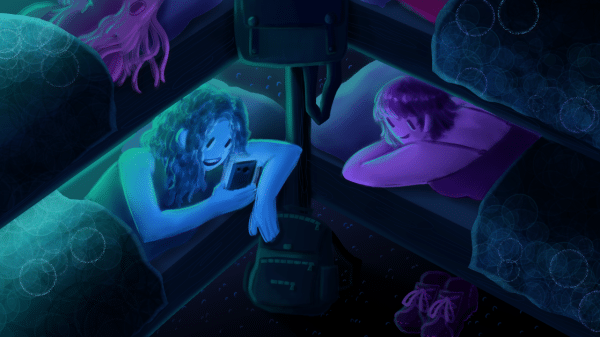
In my dreams I am always on the run. I’m escaping from a sinking ship in the middle of the ocean. I speed down a dark highway as a fire rages behind me. I’m breaking out of a collapsing warehouse as debris falls from the sky.
I don’t have an especially dangerous life. I’m not a special agent or a mafiosa crime boss. I’m a student. I go to class. I go to work. If I’m lucky, I go out on the weekend to the bars down the street. The most dangerous situation I encounter in my day to day is when I decide to eat at the campus dining hall. So, what in my life is manifesting these dreams where I always seem to be fighting for my life?
In the past three years I have noticed a trend of spiritual and health influencers keeping dream journals. The hashtag “dreamjournal” has over 66,000 posts on Instagram. The trend seems to stem from an increased awareness and proactivity toward mental wellness. Influencers on TikTok make dream journaling into an aesthetic, making artsy journal entries covered in stickers and drawings. From what I can tell on TikTok, the act of decorating the journal seems just as important as the act of journaling itself.
At first, I was skeptical, aside from the cute collages and night sky stickers, what was the point? As it turns out, the TikTokers have a scientific basis for this practice. Health and wellness publications list a wide range of benefits offered by dream journaling. According to the Cleveland Clinic, dream journaling can help process emotions, reduce stress, and improve mindfulness. Other benefits include an ability to tap into creativity and to gain insight by shining light on recurring problems.
I decided to keep a dream journal. To be clear, I’ve never been one for spirituality or mindfulness. I’d rather face the demon down than color them in my Bullet Journal. But despite my desire for a practical approach, I kept sinking with the Titanic in my dreams.
Still my pragmatic, waking mind demanded a scientific approach. Every morning, for thirty days, before the sleep-induced hallucinations slipped from my memory, I would write down every detail that I could remember. Every character, every plot point, every scene, every emotion. I would not edit the dreams I remember to make them seem more sensical.
The first week of dreams
The first week goes by without any meaningful revelations. My dreams were weird, which is normal to me. On Monday and Tuesday, a fast-food restaurant appeared in both of my dreams, which I don’t think has any symbolism beyond the fact that I was craving McDonalds. On Friday, I dreamed that a cheerleading team recruited me, despite my complete lack of gymnastic skills and pep, having never done so much as a handstand.
Many ancient philosophies and religions over years have believed dreaming to be a way to access divine wisdom. In the Bible, dreams are portrayed as a method of communication with God. In Islam, it is believed that prophetic visions may come in the form of dreams called ru’yaa. The Ancient Assyrians believed that there were three types of dreams—messages from the gods, prophecies, or expressions of the dreamer’s own psychology.

The Ancient Assyrian belief that some dreams stemmed from the dreamer’s psyche is the only piece which holds up against modern dream theory. Most modern sleep experts believe that dreaming serves some kind of function in strengthening brain activity or memory. One of the prevailing theories is that dreaming helps consolidate and analyze memories such as skills or habits. It is possible that dreams may also serve as a rehearsal for challenges that one may face in their waking life.
As interesting as these theories are, I doubted that a god was reaching out to me, whispering in my ear to go get some McNuggets. So, back to the leatherbound pages and the ballpoint pen.
Week two of dreaming
I notice recurring symbols. In at least half of my dreams, I was in a cart. Sometimes I was driving, sometimes I was a passenger, but in 50% of my dreams I spent time in a car. As a college student I don’t drive very often. I only use my car once a week when I drive to roller derby practice. So why is a car so prevalent in my dreams?
I look up what dreaming of a car might symbolize according to the Duke of Zhou’s Book of Dreams, one of the oldest known texts on the interpretation of dreams. The Ancient Chinese believed that dreams could imply things about life and the future. There was a large focus on symbols and their interpretation. The Duke of Zhou’s Book of Dreams details over 1,000 entries describing symbols and what they may mean in a dream.
Given the car wouldn’t be invented for about 3,000 more years, I looked at the entry under “carriages.” According to the Duke, carriages can have several meanings. Riding in a carriage comfortably could indicate a smooth journey, success in endeavors, and good fortune. Driving a carriage may symbolize taking charge of your life and making important decisions.
Takeaways from week three
The third week I notice that I can remember my dreams more clearly. I remember longer, more elaborate storylines. On Wednesday, I remember three consecutive dreams, each one with a different plot. In the first one I was playing handball in Christmas pajamas. During the second, I conduct class evaluations of elementary schoolers. In the last dream I was with my family in a school and the building was slowly flooding while we tried to get out.
Do I long for Christmas jammy handball? Sigmund Freud believed that dreams were a source of wish fulfillment, a method of expressing desires that would be unacceptable to polite society. Given the head-to-toe coverage of my flannels, I don’t think my psyche has a suppressed desire for flannel exhibitionism any more than to slowly drown with my family.
The fourth and final week
After three weeks of dream journaling, I was still no closer to uncovering why my dreams are full of danger. In my search for answers, I come across an academic paper titled, “The reinterpretation of dreams: An evolutionary hypothesis of the function of dreaming.” The author, Antti Revonsuo, hypothesizes that the biological function of dreaming is to simulate threatening events, and to rehearse threat perception and threat avoidance.
Are my dreams just trying to prepare me for events I might face in the waking world? Revonsuo argues that dreams have an evolutionary function to prepare and protect. He states that 99% of human history has included frequent dangerous events that threatened human survival and so recurring, realistic threat simulations led to improved threat perception and avoidance skills that likely increased chances of survival.
I am more inclined to follow the belief that dreams exist to help prepare us for everyday life. Although it is far-fetched that at some point, I’ll be forced to escape a school while water slowly rises, maybe my overactive imagination is trying to prepare me for the most unexpected scenarios.
Closing thoughts on dream journaling
As I wrapped up my month of dream journaling, I looked back at the entries I had made. I enjoyed being able to reread my dreams from weeks prior. I was able to look at the dreams from a fresh perspective, which somehow made them seem even odder and more intriguing. It was like I was recovering memories from another person.
While keeping a dream journal I couldn’t find any meaningful difference in my creativity levels or emotional processing. However, I did feel like I was gaining new insights into myself and how my unconscious mind works. Seeing my dreams written out made me pay more attention to recurring motifs. It seemed that in nearly every single one of my dreams someone from my family is present. I haven’t lived at home in three years, but in my dreams my brothers still live right down the hall.
I don’t think there is a correct method of interpretation when it comes to dreams. It is up to the individual to assign meaning to the various visions they encounter. I could listen to the Duke and accept that the cars in my dreams symbolize good fortune, but that doesn’t feel accurate to me. In time, I’m sure I’ll discover my own meaning, like finding a penny in the sand. Or maybe I won’t. Either way, the dreams will still be there, reaching out with their mysterious allure.
For now, I’m deciding to believe that my dreams exist to prepare me for the infinite possibilities of reality. As unrealistic as it is that I will have to fight a 50 foot long caterpillar with spider pincers, at least if it ever happens I’ll have a flickering sense of deja vu that I have done this before.