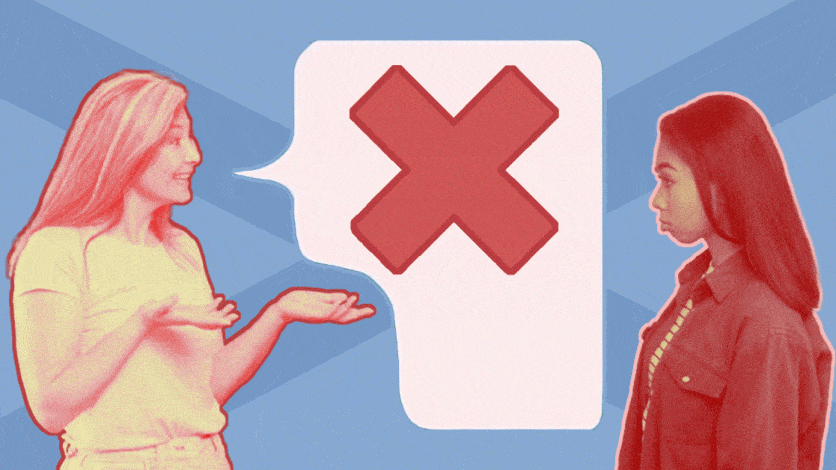
We choose to believe the worst of the world is far away. We choose to believe that while bad things happen to others, they don’t happen to us, and they don’t happen to the people we love.
Sadly, that just isn’t the case. Sexual assault is far more common than people realize. According to the National Sexual Violence Resource Center, approximately 81% of women and 43% of men report having experienced some form of sexual harassment and/or assault in their lifetime.
Survivors undergo an intense trauma when assaulted, but oftentimes what’s even more traumatic is the aftermath. Post-traumatic stress disorder is commonplace amongst survivors. Criminal and civil suits are incredibly taxing, and telling the people they love involves reliving the trauma all over again. To divulge something so personal is difficult, but there are steps you can take to ensure you provide the best support possible should a survivor come to you for support.
I spoke to several survivors—and drew from my own experience—to round up five things you absolutely should not say to sexual assault survivors.
What NOT to say: “No means no, am I right?” or any other joke.
Right after my assault, one of my friends spoke about the situation in an extremely public area—and in an extremely humiliating way. When others and I continually told her to stop, she made a “no means no” joke.
I did not find it funny in the slightest.
Humor is a worthwhile coping mechanism. It’s one I employed countless times throughout my healing, but it is a mechanism appropriate only for the survivor. It’s human nature to find light in darkness, but poking fun at such a sensitive topic isn’t the way to do it. Making jokes of someone else’s trauma minimizes it, ultimately making a very serious situation into the subject of a quick laugh.
Instead, try: “Let’s watch a movie.”
Allow the survivor space to laugh at themselves if they wish, and make it abundantly clear you’ll support them however they need. If you think they need a laugh, make them laugh in other ways! It’s not a bad idea to offer distractions during difficult moments, but pay close attention to your friend’s needs. If you’re trying to distract them, steer their minds away from the assault—don’t crash them right into the iceberg.

What NOT to say: “Why didn’t you scream or say no?”
For instances of verbal harassment or groping, it’s often difficult for victims to understand what’s happening right in the moment. Even in more severe cases, it can take sexual assault survivors years to recognize that what happened to them was wrong.
Media depictions of sexual trauma are usually quite terrible. Assault isn’t always violent, and victims don’t always put up a fight. Even if the assailant doesn’t possess a weapon, their physical and manipulative power alone is often enough to work their prey into submission. Similarly, there’s often a quiet fear involved. Neurological studies conducted by Duke University suggest that a “freeze response” when confronted by imminent danger is standard across several species. So, when a victim goes quiet or immobile during an assault, it’s usually entirely out of their control.
Instead, try: “I can’t imagine how scared you must have been.”
Imagine you’re pressing your hand into a burning stove, except you can’t pull away or scream; you can only endure. Take that empathy and utilize it to understand how terrifying it must be to be frozen in place—whether by mind or manipulation—while your body is being weaponized against you. Everyone responds to trauma in their own way. By recognizing that, you can help the survivor move forward, rather than harping on how things might’ve gone differently.
What NOT to say: “Why didn’t you report it?”
After I reported my assault, the story achieved media attention rather quickly. I was a minor at the time, so my name wasn’t attached. However, hundreds of hecklers still deemed the unnamed sixteen-year-old a liar, an attention-seeker, a “product of the Me Too movement” who was after a successful chiropractor’s money.
I fell into a deep hole, obsessively analyzing these words written by people I didn’t know who didn’t know me. One of my high school teachers told me, “If you couldn’t handle this backlash, maybe you shouldn’t have come forward at all.”
It was a cruel, terrible thing to say—but it’s the exact thing that goes through so many sexual assault survivors’ minds.
Less than 4% of sex crimes lead to conviction. Even then, the harrowing journey that awaits anyone who reports an assault is traumatic in and of itself. Survivors must recount and dissect every beat of the memory, all while lawyers, outside perspectives, and even loved ones try to undermine or refute their stories.
Instead, try: “I will support you no matter what you decide.”
Survivors have already been through something terrible, and it’s up to them to decide how they now would like to proceed. The decision to report an assault is a personal one. It’s a decision that no one else can or should make for them. Support the survivor through their inner workings and make it clear that whatever choice they make, you’ll be there for them.
What NOT to say: “Well, what were you wearing?”
Children get taken in Disney princess dresses. Teenagers get groped in party-wear. Adults get pulled into closets in work attire. I was assaulted in a medical gown. It has never mattered what the victim wore.
It’s also a common misconception that if someone wears revealing clothing, they’re “asking” for unwanted attention. This harmful idea is one of the primary perpetuators of rape culture. It’s the reason why in 2018, the lawyer of an accused rapist showed the victim’s thong in court as “proof” that she wanted the rape to happen. The rapist was found not guilty.
Dresswear is intended for the person wearing it. It’s intended to make them and them alone feel beautiful and comfortable. Any adverse and non-consensual reactions from those around them is the fault of the assailant, not the person wearing the clothing.
Instead, try: “This never should have happened to you.”
Simple as that. There is nothing a person can do to “deserve” to be assaulted. Rape or sexual assault is never justified.
Sexual assault survivors sometimes fall into self-deprecating states. They might try to rearrange blame onto themselves as their mind struggles to cope with the unimaginable. If they say, “I never should have walked home alone,” “I knew that skirt was too short,” or anything of the sort, comfort them. Reassure them that they are not to blame. Reassure them that you love them, you support them, and most importantly, it wasn’t their fault.
What NOT to say: “It was a long time ago, wasn’t it?” “You’re being dramatic.” “It could have been worse.”
Sexual assault is a unique crime. It’s as if someone broke into your home and stole your most precious belonging. Then they messed with your head to the point where every thought comes back to the thing you wish most to forget. And just for good measure, they’ve potentially bruised you up for good.
It hurts physically and mentally. It takes something from the victim that they can’t ever get back: their autonomy. They’ve had their own body antagonized, their own anatomy villainized. They’ve had their innocence ripped from them. That comfort within your own skin is difficult to rediscover after an attack.
Any form of sexual assault is traumatic, and one’s trauma cannot and should not be compared to another’s.
Instead, try: “I’m here for you.”
Even three years following my assault, I still freeze up during breast examinations and wince when I see older men. I still remember everything—I can’t ever forget it.
Sexual assault survivors don’t want to be the center of attention, nor do they want their lives to revolve around it. When enough time has passed, they’ll start to feel better. It won’t consume their every thought, but they’ll still have difficult moments. The best thing you can do for your friend is to be there for them.
The Final Takeway
So, what’s the main thing to keep in mind? Support the survivor no matter what. Sexual assault is a deeply personal, deeply traumatic experience, and there is no timeline on healing. Ensure they know they’re valid in taking as long as they need and taking up as much space as they need.