

The 98th Academy Awards have come and gone. One Battle After Another took home Best Picture and a Best Actor in a Supporting Role win for Sean Penn. Sinners made history with 16 nominations and four wins, including Best Actor for Michael B. Jordan. Hamnet and Weapons each claimed their own moments on the podium with Best Actress for Jessie Buckley and Best Actress in a Supporting Role for Amy Madigan. Now, the post-Oscar question for book lovers isn’t what films to watch—it’s what to read next.
Several of the winning films were adapted directly from literary source material. Others drew from recognizable traditions in literature. Whether you’ve already seen these films or are looking for a reason to finally watch them, the recommendations below offer a deeper look at the same worlds. These are your next reads, according to the Oscars.
One Battle After Another
Paul Thomas Anderson’s Best Picture Oscar winner is, by the director’s own admission, a loose and willfully unruly adaptation of Thomas Pynchon’s 1990 novel Vineland. Anderson has described the adaptation process as requiring him to be “rough” on the book—and it shows. The film inherits Pynchon’s anarchic California sprawl, his mistrust of authority, and his affection for characters who live outside the reach of ordinary society. Leonardo DiCaprio’s Bob Ferguson is a man defined by what he once believed and what he can no longer sustain. That tension between idealism and its wreckage is where book and film meet.
Vineland
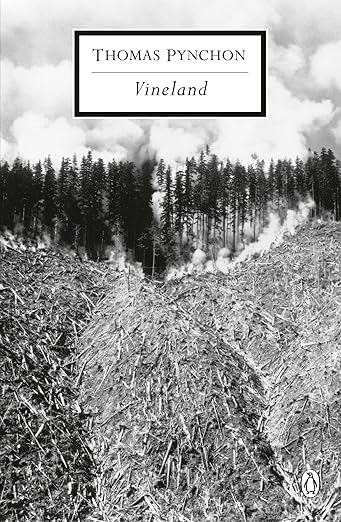
Start, then, with Vineland. Set against the Reagan-era dismantling of 1960s counterculture, the novel follows Zoyd Wheeler, an aging ex-hippie, and his teenage daughter, Prairie, as figures from their past resurface with real consequences. Pynchon writes in cascading, unpredictable sentences that mirror the novel’s world: one in which nothing is stable, authority is corrupt, and the only honest response to an incomprehensible system is to keep moving forward. Reading it alongside the film reveals what Anderson kept, what he discarded, and what he made entirely his own. The paranoia is the same. So is the dark comedy running beneath it.
Buy Vineland on Amazon and Barnes and Noble
The Monkey Wrench Gang
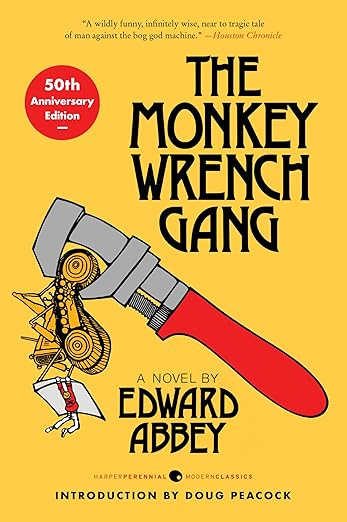
For readers who want to stay in that ideological tradition without returning to Pynchon, The Monkey Wrench Gang by Edward Abbey is the next step. Published in 1975, the novel follows a ragtag group of environmental saboteurs—a surgeon, a feminist activist, a polygamist ex-Green Beret, and a river guide—as they tear through the American Southwest dismantling the machinery of industrial development. Like Anderson’s film, Abbey’s novel treats anarchy as a form of conscience. Its characters are eccentric and funny, yet deeply serious about what they’re fighting for, even as the fight itself becomes ungovernable. The tone is looser than Pynchon’s but shares the same suspicion of power and the same appetite for characters who refuse to give in to the systems around them.
Buy The Monkey Wrench Gang on Amazon and Barnes and Noble
Martyr!
Finally, reach for Martyr! by Kaveh Akbar. Akbar’s debut novel follows Cyrus, a young Iranian-American grappling with addiction, artistic ambition, and grief. Where Vineland sprawls outward, Martyr! turns inward—but both are animated by the same restless, searching quality that defines Anderson’s film. Cyrus, like Bob, is a man haunted by the distance between who he is and who he might have been. The novel’s focus on meaning-making in the face of senselessness makes it a worthy companion to this year’s boldest film.

Buy Martyr! on Amazon and Barnes and Noble
Hamnet
Chloé Zhao’s adaptation of Maggie O’Farrell’s novel arrived on screen with the same restraint that made the book a phenomenon. Paul Mescal and Jessie Buckley anchor the film, which imagines the life of William Shakespeare and his wife Agnes Hathaway, before and after the death of their eleven-year-old son. Grief is the engine of both the novel and the film. Zhao renders the English countryside with the same attention O’Farrell brings to her prose, and the two works share a refusal to sentimentalize loss while remaining completely undone by it.
Hamnet
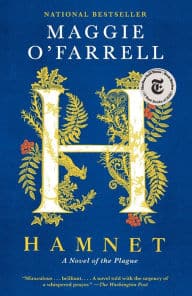
Begin with the source: Hamnet by Maggie O’Farrell. If you’ve seen the film, reading O’Farrell’s prose is its own distinct experience. Her sentences move the way memory does—doubling back and reaching for detail that feeling alone can’t carry. Agnes, in particular, is one of contemporary fiction’s great characters. She’s an herbalist, a falconer, a wife to a man who i perpetually half-absent, and a mother who refuses to accept what has happened to her son. The novel gives her the interiority the film gestures toward, and that interiority changes the entire shape of the story. It is one of the finest novels of the past decade.
Buy Hamnet on Amazon and Barnes and Noble
The Buried Giant
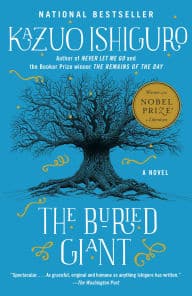
From there, Kazuo Ishiguro’s The Buried Giant offers a thematic companion rooted in a similar emotional logic. Set in post-Arthurian Britain, the novel follows Axl and Beatrice, a couple journeying across a mist-covered landscape toward a son they can barely remember. A collective amnesia has settled over the land, and this propels the novel’s central question: Will remembering destroy or restore what the couple has built together? Like Hamnet, it is a book about marriage under the weight of grief, survival strategies constructed around unspeakable loss, and whether the truth strengthens love or threatens it. Ishiguro’s restraint matches O’Farrell’s, and the two novels in conversation become something larger than either alone.
Buy The Buried Giant on Amazon and Barnes and Noble
Big Fish: A Novel of Mythic Proportions
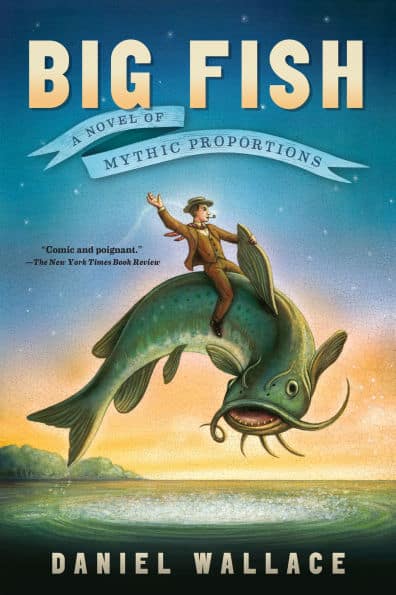
For something more unexpected, consider Big Fish: A Novel of Mythic Proportions by Daniel Wallace. A son attempts to reconstruct the true story of his dying father through the elaborate tales the man told throughout his life. The novel is shorter and warmer than either of the above recommendations, but it shares Hamnet’s central focus on how we mythologize the people we love and how the stories we build around them outlast the people themselves. Shakespeare, in both O’Farrell’s novel and Zhao’s film, does something similar—he transforms his son’s death into art, and the novel asks whether that transformation is a gift or a betrayal. Wallace asks the same question from a different angle.
Buy Big Fish: A Novel of Mythic Proportions on Amazon and Barnes and Noble
Weapons
Zach Cregger’s Weapons won Best Supporting Actress at this year’s ceremony. If the award generated curiosity about a film that flew somewhat under the mainstream radar, good—it deserves the attention. The film goes beyond folk horror; in a small Pennsylvania town, seventeen children vanish in the night, all converging on a single house. Their third-grade teacher goes on administrative leave. A grieving father begins his own investigation. What unspools is a community mystery wrapped around something far older and stranger: a parasitic supernatural figure named Gladys who feeds on the children she lures, controls, and keeps captive.
HEX
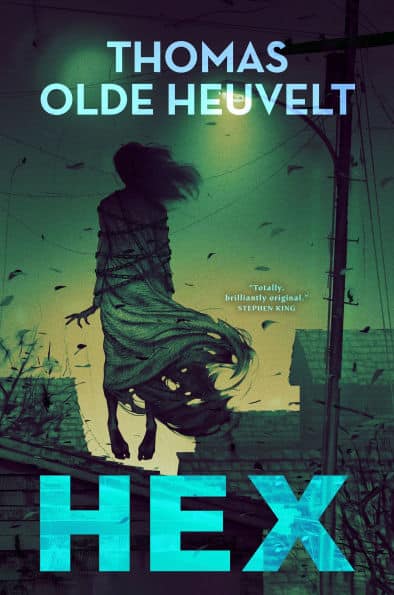
Cregger wrote Weapons as an original screenplay, so there is no source novel to return to. But HEX by Thomas Olde Heuvelt is a close literary counterpart. The novel centers on Black Spring, a small American town haunted by the centuries-old witch Katherine van Wyler. Her presence has so thoroughly colonized the community that the residents are unable to leave. Heuvelt examines the same phenomenon as Cregger: not the monster itself, but what living beside a monster does to ordinary people, and in HEX‘s case, across multiple generations. The town of Black Spring has built an entire surveillance infrastructure to manage Katherine, and the normalization of horror—the bureaucratic, communal management of something that should be unmanageable—is exactly the kind of dread Weapons traffics in.
Buy Hex on Amazon and Barnes and Noble
The Elementals
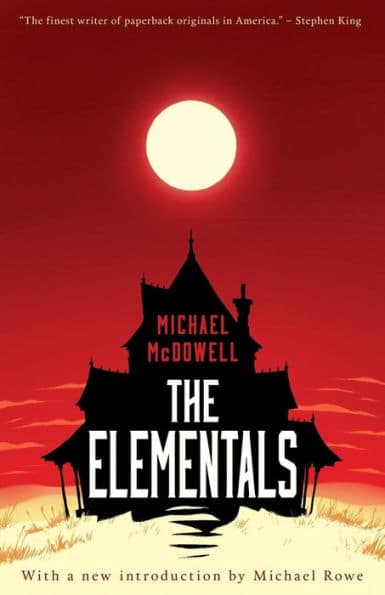
A second recommended read is The Elementals by Michael McDowell. Published in 1981 and recently rediscovered by a new generation of horror readers, the novel follows two Alabama families sharing adjacent beach properties, one of which contains a third, uninhabited house—and something ancient living inside it. McDowell’s writing makes dread accumulate slowly and almost imperceptibly, which is exactly Cregger’s method in Weapons. Both works examine the vulnerability of children and the failure of adults to protect them until it’s nearly too late.
Buy The Elementals on Amazon and Barnes and Noble
Sinners
Oscars history was made before a single award was handed out. Ryan Coogler’s Sinners arrived at this year’s Oscars with 16 nominations—the most in Academy Awards history—and left with four, including Best Actor for Michael B. Jordan. Set in the Mississippi Delta during the 1930s, the film follows twin brothers Smoke and Stack, who return home to open a juke joint and find themselves facing something they cannot outrun: vampires. They battle against supernatural horrors, yes, but also the Jim Crow South itself, in all its organized, sanctioned brutality. Coogler deploys genre conventions to tell a story about joy and survival, about the blues, and about what it costs a community to exist in a country that would prefer it didn’t.
Sing, Unburied, Sing
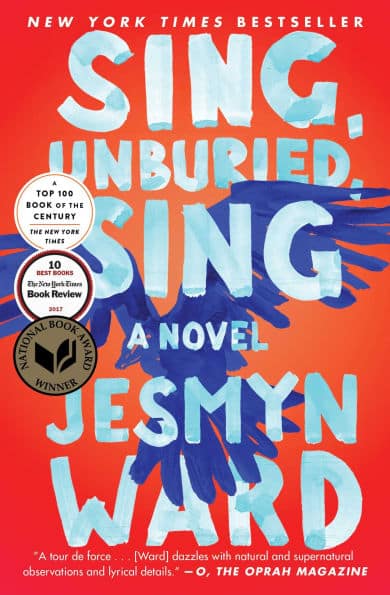
Two books belong beside it. The first is Sing, Unburied, Sing by Jesmyn Ward, winner of the 2017 National Book Award for Fiction. Ward’s novel follows Jojo, a thirteen-year-old boy, on a road trip across Mississippi to collect his father from prison. The journey moves between past and present and refuses to treat the supernatural as anything other than a natural extension of historical trauma. Like Sinners, Ward’s Mississippi is a place where the violence of the past is present, embodied, and hungry. The novel shares the film’s multigenerational scope, its attention to Black Southern life, and its insistence that grief and joy are inseparable.
Buy Sing, Unburied, Sing on Amazon and Barnes and Noble
The Buffalo Hunter Hunter
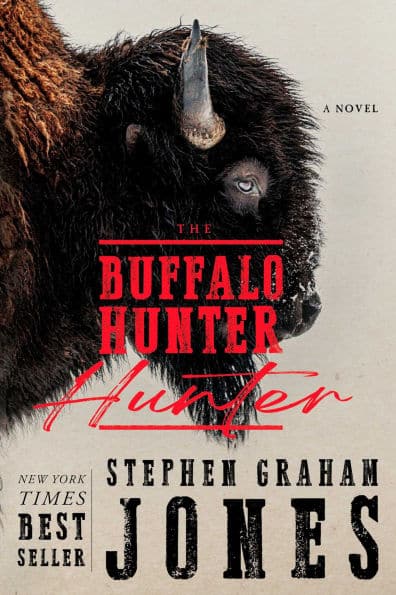
The second is The Buffalo Hunter Hunter by Stephen Graham Jones. Jones’ novel follows Good Stab, a Blackfeet man who becomes a revenge-seeking vampire after a series of massacres devastate his reservation in the nineteenth century. The book reanimates vampire mythology in the same way Sinners does—as a framework for asking who survives history and at what cost. Where Coogler locates his horror in the Delta blues tradition and the terror of Jim Crow, Jones locates his in the history of Indigenous dispossession and massacre. The two works are in conversation about what American horror really looks like when you pull back the genre curtain.
Buy The Buffalo Hunter Hunter on Amazon and Barnes and Noble
Letting the Oscar Winners Take the Reins
The Oscars have always reflected something about the cultural moment. This year, that reflection is literary. From Pynchon’s paranoid California to O’Farrell’s grieving Stratford-upon-Avon, from the haunted Delta of Coogler’s imagination to the terrorized streets of Cregger’s Pennsylvania, the films that defined this awards season are in constant conversation with the written word. And the books are where the Oscars’ cultural conversation continues.