The day HB 1570 passed in the Washington State House, my housemates and I celebrated.
One of us is a member of Western Washington University’s Union—WAWU (Western Academic Workers United). They’ve fought for years for a law that would allow them to negotiate with the University for fairer contracts.
HB 1570 allows for collective bargaining for certain employees who are enrolled at public universities. Passing it has been the effort of years.
Resolution supporting student workers is challenging to get passed. WWU has held multiple picket lines over the past few years, while the university administration puts up delays and roadblocks.
They don’t take us seriously!
WAWU member, anonymous for privacy
Student workers who are no less deserving of fair pay often don’t get it. Students work to pay rent, groceries, and other bills, just as anyone else.
The myth: school prepares us for the real world
Over and over again, I was told that school is preparing me for the real world. Tests teach you recall, supposedly, or memorization. Unless you are going into an emergency-situation profession, such as an ER doctor, you’ll probably have access to a search engine in your job.
In any real job, however, bosses have told me to ask a coworker rather than try to guess the answer to a question. Grade school, K-12, places so much emphasis on achieving high grades that it teaches kids to pretend at excellence, rather than learn, at a young age.
Jack Schneider, for The New York Times, asks if A-F grades are truly as useful as we say they are.

Letter grades do several different things, none of them well, and the result undermines student learning.
Jack Schneider, professor at the University of Massachusetts
The grade school system doesn’t have kids’ best interests in mind. Students graduate knowing algebra, not de-escalation of a social conflict, which many people in many professions are more likely to need.
Wouldn’t it be wonderful, for example, if high school taught us how to file taxes?
The reality: we prepare ourselves for the real world
But it doesn’t. Neither does it teach self-advocacy or political organization. I did not learn to demand fair treatment in the workplace from school. Students who want to advocate for change must source their own current issues related to education from the internet and figure out how to make a change all on their own.
An article titled “Should Protests Be A Part of College Culture” by Simone Tillman at Trill argues that students have been participating in protests for a long time. Recently, in a trend Columbia University started, students have been holding “encampments in the name of divestment.”
This means camping out—literally, with tents—in a public university space, and staying until the university renounces the cause students are fighting against.
Politics are integral to education
Simone Tillman
They go on to state that history at multiple levels is taught in US classrooms; of course, students who want to partake in history will do something about it. We don’t just learn politics, we participate in it.
As a college student myself, I agree. When the Global Sumud Flotilla undertook the journey to deliver food and aid to Palestine, I watched, pulled out a note card, and I wrote “I learn so I can protest.” I taped it to my desk. I look to it when I feel demotivated, depressed, or defeated.
Motivation, where do I even start?
After I got home from the No Kings nationwide protests, I spent hours watching videos of the turnout from people across the United States.
It’s hard to focus on assignments while the world burns and civilians are bombed. I’m studying for a degree that will help me make an impact, and that note card motivates me.
Nothing in school taught me to turn my grief into motivation to create change; I did that all on my own. I had to teach myself to wade through terrible news and keep working. I had to teach myself how to channel my terror into motivation.
When I graduate with my degree, I will use it to advocate for literacy and accessibility to creativity, because I believe it’s the right thing to do. No test or professor taught me that.
When students advocate for change, they’re not just playing at history, they are adults advocating for real change. When they unionize, they’re not following a guidebook. They’re creating their future.
Protesting in the modern day
In History classes, they teach us that America was created by protests. The Boston Tea Party, for example, was perhaps one of the most well-known protests of the American R
In more recent history, college students protested the War in Vietnam. The image below is from 1968, provided by the Bill of Rights Institute. That’s only two generations back; my Náná was 23.
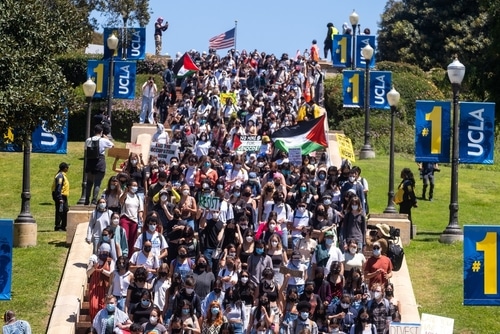
From the past to today, protesting is a connection between college students and the public political sphere.
Continuing from this history, Gen-Z is protesting in more ways than marches. They’re pushing back against “grind culture,” AKA the drive to be constantly working or being productive.
Sometimes the way to protest is to yell in the street. The less glamorous side of protesting is sleep. Everyone wants to do something, but when the system is demanding the grind, we can also protest by doing nothing.
The opponent in this case isn’t so obvious as the national guard being sent into a city; it’s the mindset we’ve all been taught, the one that says, “you’re being lazy.”
In an unfortunately member-only Medium article, Devon Price describes their experience as a graduate worker without union representation.
I never had the freedom to challenge them on anything. They held the keys to my future entirely in their hands.
Devon Price, author of Laziness Does Not Exist
They want us to burn out, so we’re too tired to fight. In response, I practice not guilting myself for taking breaks. This is challenging because we grew up around people advocating for turning our hobbies into money,
Think of all the stories of a kid selling lemonade to make some extra money for their parents: that’s not heroic, it’s horrifying.
We shouldn’t have to hustle to live
In an article titled “Breaking the Hustle Before it Breaks You,” Faith O’Hagan at Trill detailed how the constant work was exhausting her. “I thought the problem was me,” she said, “that I wasn’t managing myself properly.”
But there are only 24 hours in the day. We can’t do everything.
Society pushes us to work more, do more, make more, and be more.
Faith O’Hagan
So we’re tired, stressed, overworked, and treated unfairly on top of it. Is anyone surprised that students need a break? The systems that benefit from our labor certainly won’t give us one! So we must advocate for ourselves.
The makings of a union
When workers aren’t treated fairly, they demand to be so.
Often, the greatest power workers have is to withhold their work: Companies literally cannot run without it. Strikes exist for this purpose. Workers know they are essential to the company, and so by refusing to work, they create an ultimatum. The company can negotiate fairer treatment, or it can go bankrupt.
On their website, the AFL-CIO says, “Organizing a union in your workplace is about getting more rights and more power.”
They have a page called “4 Steps to Form a Union.” Those four steps involve talking to your coworkers and finding a union organizer, so the group can unify their voices in a single, resonating declaration for better wages, benefits, and working conditions.
However, if you’re a student, you may not need to make a union;, one probably already exists.
Try searching the name of your university + “union.” You should contact the union representing student workers at the university you work for.
If you’re not employed by your university, reach out anyway. Ask if they’re currently fighting for representation, and what you can do to help.
Student workers organize and run their unions. The University did not teach them how; it did not give them the resources: students created the legal representation they needed.
Students are real workers, just as deserving of safe conditions and decent pay. When the system fails us, we fight back: protesting, striking, and demanding fair treatment.