Korean band The Rose has a moving story of adaptability, collaboration, and ambition, as shown in their well-paced and edited new documentary. But The Rose: Come Back to Me falters in its noncommittal critique of the harmful K-Pop industry/culture that cost these very endearing guys so much unnecessary and unjust harm.
Much like how the K-Pop industry (and fandom) can be scared of any implication that idols are real people too, The Rose: Come Back to Me presents a story of unnecessary struggle while often carefully skirting around decisive criticism of the industry that caused said struggle. I understand why The Rose hesitates to say something controversial, but this ultimately prevents the good documentary from becoming a great one.
An enjoyable band, and an even more enjoyable story.

(Credit: Richard Hama)
The first time I’d ever heard a song by The Rose was this documentary’s opening scene: their 2024 Coachella performance. However, the subsequent eighty-or-so minutes did a wonderful job at introducing them — and I imagine, reintroducing them for long-time fans — such that, even though their music may not particularly appeal to me, I did find them very likable and as people (or in the cinematic sense, characters) with a story more than worthy of a documentary.
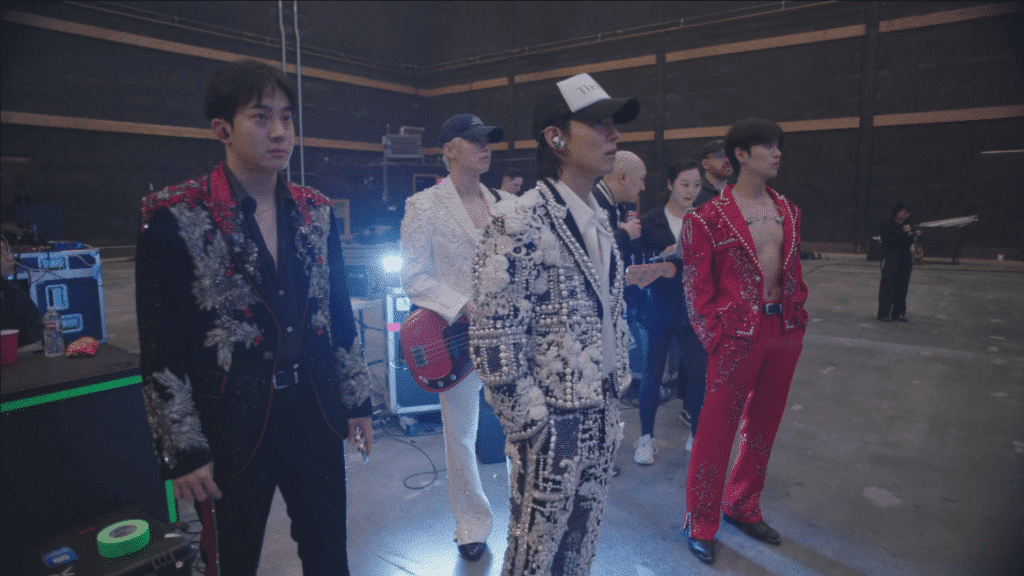
The band members include Sammy, who’s pushed to go solo, Dylan, their multi-talented drummer, Leo, the band’s de facto producer, and Jeff, the spiritual leader whom the others look to.
Perhaps what’s most refreshing about this documentary is how authentic it feels. They don’t shy away from highlighting the preferential treatment Sammy — who joined the group last, no less — receives, and how it impacts his relationship with the other members.
Bands are often marketed as if they have perfect interpersonal relationships with no conflict whatsoever, so it’s nice to see this idea be clearly negated. But perhaps even more so, it was eye-opening to see how these cracks were intentionally magnified by their team; emblematic of how terribly the K-Pop industry treats it’s stars.
So when Jeff says, “K-pop, as a genre, paved the way. And because it paved the way we’re able to perform and be apart of the new landscape. I feel grateful for that,” it doesn’t feel necessarily authentic. But rather, a conscious decision to ensure that viewers don’t see The Rose as being against the K-Pop industry. Though I couldn’t help but wonder, why shouldn’t they be?
Scared of the magnitude of it’s own story.

(Credit: Jaehyeong Lee)
Even if all the members did benefit from their training, their success ultimately occurs in spite of the K-Pop industry, not because of it. Paradoxically, the film emphasizes this to invoke in viewers the respect The Rose deserves, but also stunts the impact of said sentiment by tripping over itself to functionally say ‘but the industry isn’t that bad.”

It’s just somewhat frustrating to see the film be unafraid to criticize the racism inherent in how Americans treated Far East Movement (of “Like a G6” fame), but so hesitant to clarify that the K-Pop industry is desperately in need of reformation, or that smoking marijuana isn’t that bad.
I’m far from familiar with Korean culture or customs, but what about a teenager smoking marijuana warrants officers tying a rope around him?
As the documentary progressed, building back to their Coachella performance, it evoked a true sense of the nuanced connections the boys have, rather than mere co-workers to be swapped in and out of groups like an athlete.
Even if it’s not my taste, I enjoyed how their music (as presented in the documentary) felt in no way shallow or manufactured. These are not only the songs they want to make, but the songs they need to make, as if doing anything else would be unnatural. In my eyes, that is true artistry.
The Rose: Come Back to Me is refreshingly personal, carefully teetering back and forth between moments of immense sadness and on-stage prideful realizations of success.
More than just another music documentary.
(Credit: Richard Hama)
The editing resembles a certain level of taste and specificity that I think is worth highlighting. Animated sequences used briefly throughout the film to highlight the emotion of certain memories, or smartly fill in the blanks for pivotal moments that weren’t aptly recorded; smoothly transitioning between major moments, never in a way that had me confused on how much time had past or feeling lost; and a great understanding of the fundamentals of storytelling, which often can get lost in music documentaries that prioritize the glory of their subjects.
Considering how quick of a watch it is, the great story it follows, the very charming and likeable stars, and the exceptional editing (no less for a non-experimental documentary) I would more than recommend The Rose: Come Back to Me. Even if you’re not a fan of The Rose, like me.
As much as The Rose’s story is one of perseverance, their film is ultimately one of hesitance (that at times seems incongruent with the pridefulness and decisiveness of its subjects).
Through their story, The Rose shows that the K-Pop industry and its fans must change, and can do so while still producing successful artists. Unfortunately, The Rose: Come Back to Me actively refuses to push for such reformation, despite exemplifying its necessity, even if the film remains a very captivating cinematic experience— again, thanks to the artists, but not the industry that cages them.
Rating: 7/10 silver roses
The Rose: Come Back to Me premiered at the Tribeca Film Festival in June of 2025 and was released theatrically this February. For more information on where/how to watch it, visit the film’s website.