


The novel has always made room for experimentation. From the beginning, writers have bent reality, toyed with time, and explored unlikely scenarios. Romance thrives on this flexibility more than most genres. It openly embraces the improbable under one guiding idea: Love can make almost anything feel possible. When desire drives a story, and curiosity pulls readers forward, then even the most unlikely premise becomes believable.
In recent years, that elasticity has taken a particularly strange turn. On BookTok, readers film themselves crying over love interests that, on paper, sound like punchlines: a sentient door, a sentient blob, an airplane, a piece of sentient architecture. What began as a niche curiosity has evolved into a recognizable subcurrent within romance publishing. Some approach it ironically; others defend it earnestly. Comment sections swing between disbelief and sincere emotional investment.
At first glance, these stories seem like the natural next step in the genre’s long history with the nonhuman—after vampires, aliens, and shadowy monsters, maybe a door was only a matter of time. But the intensity of reader attachment suggests that this is more than a gimmick. The real question isn’t just why writers are bringing objects to life, but why readers are responding to them with such strong, genuine feelings.
What is sentient object romance?

The sentient-object romance (or erotica) may seem frivolous at first glance, but its appeal points to a subtle shift in how we understand intimacy. These stories reveal something real: a growing interest in love untethered from bodies, timelines, and social pressure. What’s left is steadiness, projection, and the freedom to imagine intimacy on new terms.
Sentient-object romance is a niche subgenre in which the romantic interest is an inanimate or non-human entity, often imbued with personality, consciousness, or symbolic significance. While the premises may seem fantastical, the narratives generally follow the familiar structures and emotional beats of conventional romance: attraction, longing, intimacy, conflict, and resolution.
A growing niche within romance fiction, sentient-object romance centers on a relationship between a human character and an object granted consciousness. These objects are typically inanimate in the real world, without voice, thought, or agency. But in the stories, they become emotionally legible partners.
Unlike fantasy or sci-fi, which generally operate within clearly defined world-building rules, sentient-object romance is more fluid. Some objects remain physically unchanged, communicating without becoming human. Others shift into humanoid form while retaining traits of their original material identity.
Over the last five years, romantic leads have shifted yet again, from superhuman beings to the nonhuman, and sometimes even the non-sentient. While absurd at first glance, this trend represents a logical extension of the genre’s long fascination with imaginative, unconventional love.

Dissatisfaction with modern love
In an age oversaturated with digital craftsmanship, consumer culture has seeped into our understanding of love, reshaping it in subtle but consequential ways. We curate love, packaging it into something marketable. Relationships no longer unfold solely between two people; they play out before an invisible audience armed with theories and timelines.
Social media platforms circulate tidy frameworks: the “three-month rule,” the “if they wanted to, they would” mantra, or the so-called taxicab theory, which claims to decode romantic behavior. When couples fail to follow these scripts, audiences rarely treat the deviation as circumstantial. Instead, they interpret it as evidence of a deeper flaw.

Consumer culture and digital platforms have transformed intimacy into a performance, where love must conform to social scripts and visible metrics. In Cold Intimacies, professor of sociology Eva Illouz makes a provocative case: Capitalism didn’t just shape markets—it shapes our hearts. Over the course of the twentieth century, middle-class men and women were coached in the delicate art of self-management. They monitored, performed, and even monetized their feelings—whether in the office or at the dinner table.
Love, longing, and heartbreak were never entirely private; they were on display, scrutinized, and bound up with the economic and social rules of the game. Emotions became a performance, and the self became an ongoing, curated project of making feelings socially respectable.
Am I really falling in love with a sentient object?
Some of the discourse within the romance fiction genre focuses on the reader’s positionality, specifically when the reader surrenders and leaves behind reality. This leads to concerns about their so-called “imaginative disposition” and how that might jeopardize them. Critics worry that readers cannot distinguish fiction from reality and that surrendering to the story puts their emotional judgment at risk.
Yet these anxieties about reader vulnerability are largely contested within online reader communities themselves, where fans discuss, critique, and contextualize the stories they consume. In the outer edges of BookTok, where increasingly specific subgenres find devoted audiences, one such prominent creator is @grapiedeltaco. With more than 150,000 followers, she discusses books alongside political commentary.
Her introduction to the genre came in August 2022, when curiosity and a bit of irony prompted her to pick up her first title, Squeak by Vera Valentine—a story about a red balloon animal. At the time, she assumed it was a novelty—something readers engaged with for shock value rather than sincerity. But as she read further, she began to notice something else: an expanding body of work.
“I went into it as a joke, which I’m sure a lot of other people do,” Grapie says. “But then I realized this is an ever-expanding genre, with its own history, and there were moments that made me laugh, alongside genuine earnestness and expressions of care between characters.”
While some readers approach the genre as a novelty, others believe that it offers a lens for exploring deeper questions about love, connection, and social expectations. For Grapie, the appeal goes beyond the humor and the strangeness of the premise.
“I think what’s really great about the sentient-object as a whole is [that it’s] a real connection based entirely on a soul. It’s the true test of whether love is blind. Does love truly need the outsides to match preconceived expectations and traditional standards?”
Love without bodies
Fret not—no one is running off to propose to their toaster or abandoning their embodied relationships for a well-structured narrative arc and a charismatic air fryer. But if the beloved can be a door or a plane, then the physical form becomes secondary to something else. Sentient-object romance frees intimacy from aging bodies, beauty hierarchies, gendered expectations, and biological timelines. What remains is not spectacle but consistency: attention, ritual, and emotional devotion.
In sentient object romance novels, love no longer depends on physical compatibility or reproductive futurity. Instead, the story defines love through presence, symbolic meaning, and the steady reliability of attachment.

Freed from corporeal constraints, desire becomes less about attraction and more about emotional constancy. The object does not betray, does not age, and does not negotiate its own subjectivity in unpredictable ways. It is a stable surface onto which longing can be projected. These stories distill romance to its most elemental components—yearning, devotion, and the desire to be chosen.
This shift may sound radical, but it echoes a much older insight. In A Lover’s Discourse, Roland Barthes suggests that the beloved is never fully a person, but a figure. They are a projection shaped by language and longing. We do not simply love someone—we construct them, investing them with meaning that exceeds their material presence.
Sentient-object romance makes this dynamic literal. Instead of pretending the beloved is a fully knowable subject, the genre shows what has always been true: Love depends on projection and symbolism as much as on reciprocity.
What does this mean for the genre of sentient-object romance?
The political resonance of this subgenre, as author Chuck Tingle suggests, echoes the rhetoric conservatives used during debates over same-sex marriage. In their arguments, exaggerated hypotheticals—“What’s next?”—invoked fear and ridiculed the expansion of intimacy, conjuring scenarios of marrying objects or other implausible partners.
Sentient-object romance, in an unexpected turn, inhabits those once-dismissed possibilities. By treating the implausible as possible, the genre subtly answers the rhetorical question that was meant to foreclose discussion.
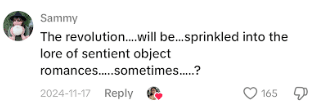
At first glance, romance involving inanimate objects may be hard to understand. But the genre offers something deeper: a space free from conventional constraints, where questions about love, identity, and social norms can be tested.
The exaggerative qualities that characterize sentient-object romance do not undermine its credibility. Rather, such qualities highlight how deliberately experimental contemporary romance has become. As Grapie notes, its unconventional methods allow for probing of familiar genre conventions.
“It makes for a very brand new take on very familiar conflicts, like feelings of physical inadequacy, questions of attraction, and curiosity surrounding intimacy. But I do think the very unserious approach to it all makes it more freeing to explore.”
In this sense, sentient-object romance proves politically and philosophically revealing. The genre is an avenue for experimenting with human connection in ways that traditional narratives typically do not allow.
Sentient-object romance channels the experimental and absurd qualities that consistently appear in art and culture. When societies face difficult or destabilizing times, creators rebel and critique through unconventional forms. Just as artists launched absurdist and abstract movements in response to historical crises, sentient-object romance challenges norms and pushes the boundaries of conventional storytelling.
“We can see a lot of really absurdist and abstract art movements being born from really dark periods in time. There is an art movement called the Dada movement that was born from World War I, but the basis is absurdist movement. We see the same way with sentient-object romance; it’s natural for humans to rebel and do something odd when times get really detrimental.”
Absurd, but not accidental
If romance has adapted to satisfy unmet emotional needs, then inanimate-object romance is less an anomaly than an evolution. Stripped of aging bodies, biological timelines, and the performance of desirability, the stories break down intimacy into its most abstract elements: consistency, attention, and symbolic meaning. What initially feels absurd can instead be interpreted as diagnostic.
In a cultural moment that is both skeptical of permanence and conscious of how love is shaped by capitalism and visibility, these narratives test what remains when the body falls away. The object is not merely a gimmick but an absurdist device that pushes romantic logic to see whether emotional charge survives. The subgenre’s persistence indicates that readers are not chasing novelty so much as searching for connection untethered from status and inevitability.
Far from signaling the end of romance, inanimate-object romance reveals its resilience. Even when deprived of the human form, love continues to demand meaning. The question is not why anyone would fall for an object. The question is what this hypothetical illuminates about our conceptions of attachment, intimacy, and the fragile architecture of desire.